Confirmed facts
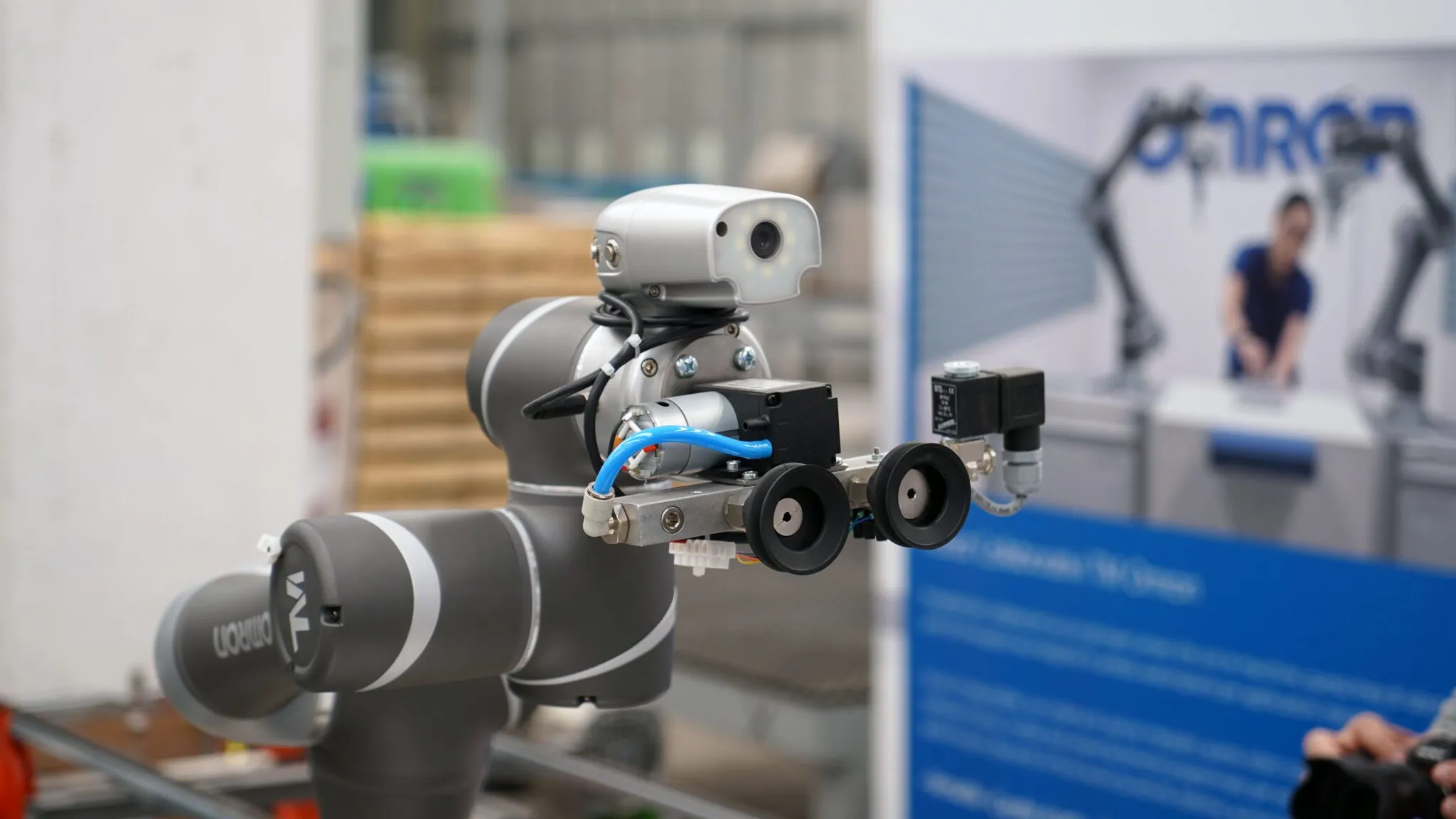
OMRON Robotics has published an end-of-life notice for its HW3.2 collaborative robots, turning a routine product transition into a concrete planning issue for factories still running TM5-900, TM5-700, TM12, TM14 or TM20 systems. The notice sets different order and shipping cutoffs for Europe and other markets, keeps support open until March 2032, and warns that the replacement is not a drop-in software or hardware swap.
Source statements
What changes for an installed fleet
Newsroom analysis
OMRON's discontinued-products page lists the HW3.2 family as the product being phased out. The last order date is December 2026 in Europe and March 2027 outside Europe. The last shipment date is December 2026 in Europe and April 2027 outside Europe. The more detailed HW3.2 discontinuation notice gives the cutoffs as December 1, 2026 and March 31, 2027 for final order entry, followed by December 31, 2026 and April 30, 2027 for last shipment. Those deadlines do not mean an installed robot stops working. OMRON says scheduled maintenance closes at the end of March 2032, and lists spare parts that are expected to remain available through the support period. For a production manager, the immediate question is therefore not whether to remove every HW3.2 arm, but whether a cell's next maintenance event, software change or safety review will expose a migration dependency. Why the migration is not plug and play OMRON recommends HW5.0 units, mainly the TM S family, for most of the standard HW3.2 models. The notice also says there is no recommended replacement for TM16 units or the HW3.2 food-grade-grease variants. That distinction matters in regulated, hygienic or space-constrained cells: a replacement decision may require a new application design rather than a simple part-number substitution. The published comparison identifies several integration differences. HW3.2 has three COM ports, while HW5.0 has two. The I/O arrangements also change, including connector layouts and the available analog I/O. OMRON notes dimensional changes around joints J5 and J6, and the comparison adds EtherCAT on the newer version. These are measurable reasons to re-check cabinet wiring, tool clearances, cable routing, fieldbus configuration and the robot's mounting geometry before approving a retrofit. Software deserves the same scrutiny. HW3.2 is operated with TMFlow 1.88 or earlier, and OMRON does not recommend running it on the TMFlow 2.xx framework because projects may not transfer smoothly. A cell inventory should therefore record the controller, project files, plug-ins, external vision configuration and backup procedure—not just the arm's model label. If a line depends on a legacy project that nobody has opened recently, the migration risk is already operational, even if the robot is still cycling. Safety is part of the business case The notice is unusually explicit about the safety reason for the change. OMRON says HW3.2 does not meet the mandatory requirements of the European Machinery Regulation it identifies, while its recommended HW5.04 series or later is intended to comply. The document compares HW3.2's stated safety architecture—ISO 13849-1:2015, Category 2, PL d—with the HW5.0 entry of ISO 13849-1:2023, Category 3, PL d, alongside the other certificates OMRON lists for the newer family. That statement should not be read as a universal approval of a complete workcell. A cobot's status depends on the integrated tool, gripper, fixtures, speeds, modes, safeguarding and workplace risk assessment. A newer arm does not automatically make an old cell compliant. Before a migration, the responsible team should preserve the existing risk assessment, identify every safety-related control function, verify the new robot and end effector as a system, and document validation tests after commissioning. What the published numbers do—and do not—tell buyers OMRON's comparison shows HW3.2 payloads from 4 to 20 kg, versus 5 to 30 kg for HW5.0. It also lists 360-degree freedom on several joints in the newer family, a J6 speed of 450 degrees per second instead of 225, and repeatability figures of ±0.03 mm for several S-series models and ±0.05 mm for TM20S. Those figures can help screen candidate replacements, but they do not prove that a migrated cell will keep the same cycle time, reach every taught point or handle the same tool safely. The practical deployment decision is a staged one. First, freeze a complete baseline of the HW3.2 cell: robot and controller identifiers, TMFlow version, I/O map, payload and tool data, safety settings, cycle-time evidence and known faults. Next, compare the replacement's envelope, connectors and software path against that baseline. Then validate the application offline where possible, followed by a controlled commissioning run with the required safeguarding and a documented risk review. If the application uses TM16 or food-grade-grease hardware, escalate early because OMRON does not name a direct replacement. OMRON's announcement is therefore less a product launch than a lifecycle signal. Existing HW3.2 fleets still have a defined support window, but the window is not a reason to defer all planning: regional order and shipment cutoffs arrive before maintenance ends, and the published differences reach into software, wiring, mechanical fit and safety validation. For professional users, the useful capability is not a headline payload increase. It is the clarity to decide which cells can be migrated, which need redesign, and which should remain in service only with a documented support and safety plan. Official sources Official source: robotics.omron.com Official source: robotics.omron.com Related reading Nvidia Open World Models Field Robot Development Nasa Orbital Robotics Payload Challenge Explained