Confirmed facts
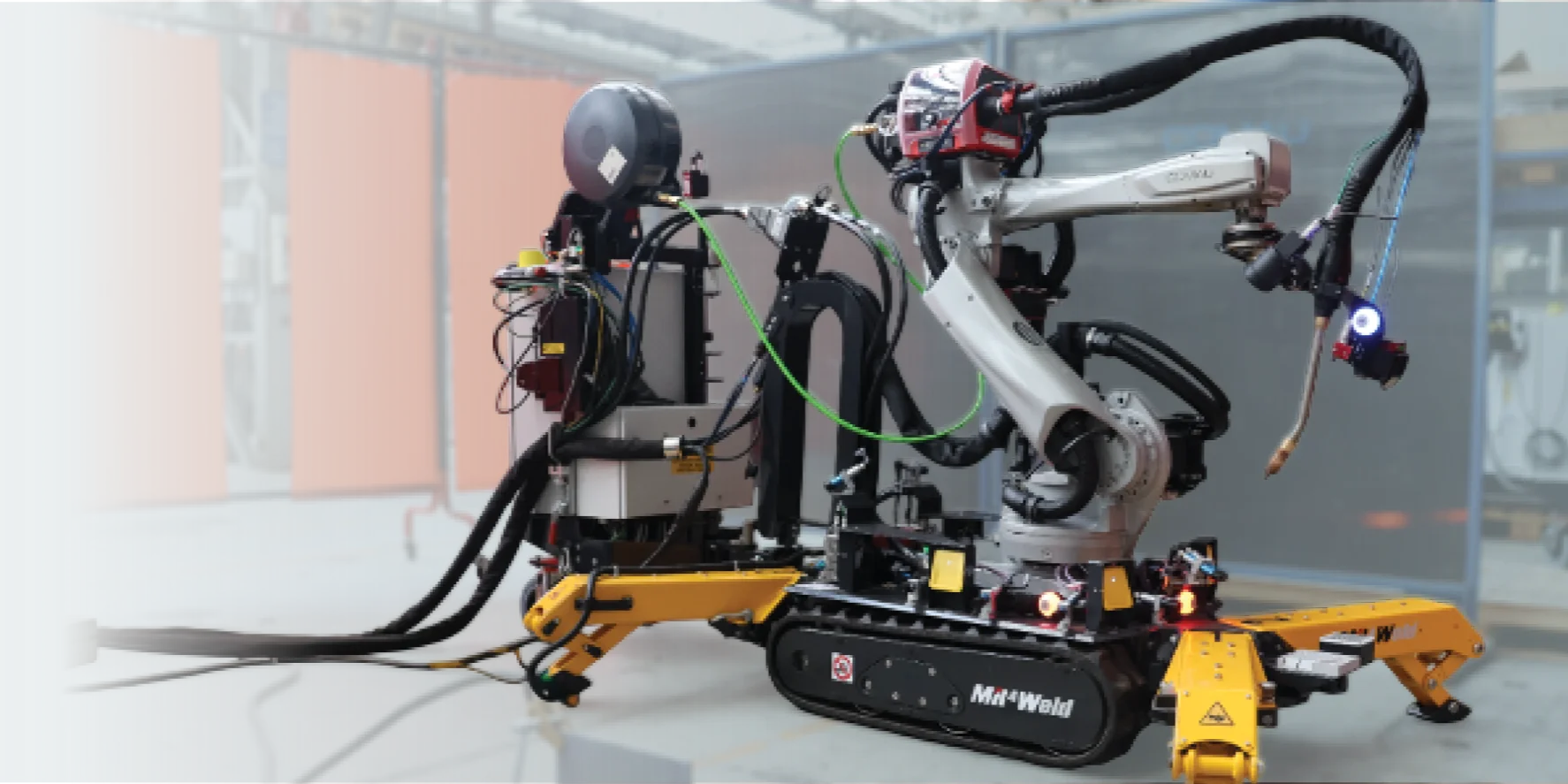
Comau is presenting its MR4Weld mobile welding robot as a practical answer to one of industrial automation’s harder problems: moving robotic welding beyond fixed factory cells and into large, changing structures. In its Hannover Messe 2026 announcement, Comau says the system, developed with shipbuilder Fincantieri, can autonomously weld up to 170 metres of steel in a single shift — three times the output of a manual process.
Source statements
That is a significant operational claim, but it is still a manufacturer-reported figure rather than an independent benchmark. The announcement does not specify the weld geometry, steel thickness, seam preparation, shift length, number of stops, rework rate or conditions used for the comparison. Those details matter when a shipyard decides whether a mobile welding robot can deliver repeatable production value rather than an impressive demonstration.
Newsroom analysis
What Comau is putting forward MR4Weld combines a tracked mobile base with a six-axis articulated robot, a welding torch and an integrated vision system. The robot is designed to identify welding joints and operate on large steel structures in unstructured environments, including ship units and blocks. Unlike a conventional robotic welding cell, the system can move to the work rather than requiring the workpiece to be brought into a dedicated enclosure. Comau’s own MR4Weld product information describes the platform as an outdoor automation solution for labour-intensive welding. It says a single operator can manage the robot during transfer and welding without specific robot-programming expertise. Digital tools collect welding and production data, including records of welded joints, giving the operator and production team a way to track what the system has completed. The announced 170-metre figure is therefore best understood as a throughput target tied to a particular operating model: mobile deployment, autonomous welding, vision-assisted joint identification and one-person supervision. It does not mean that every shipyard, steel structure or welding task will reach that output. Why mobility changes the deployment question Shipbuilding and heavy fabrication expose the limits of fixed automation. Workpieces are large, access routes change, surfaces are not always uniform and production takes place across multiple decks or sections. A stationary robot can offer excellent repeatability inside a controlled cell, but the cell itself becomes a constraint when the job cannot be brought to it economically. MR4Weld addresses that constraint by making the robot part of the material flow. The tracked platform can be repositioned between work areas, while the arm and vision system handle the welding task. This approach could reduce the need for repeated manual welding on large structures and allow automation to reach areas that are difficult to enclose. It also shifts more responsibility onto navigation, setup, surface preparation, cable management and recovery after an interruption. Comau’s earlier MR4Weld announcement with Fincantieri described the system as a mobile solution intended for steel structures during vessel construction and reported that production tests were underway. The 2026 announcement confirms that Comau continues to position the platform for industrial use, but it does not publish a new customer-site performance report or a third-party validation study. The safety claim needs careful reading Comau says MR4Weld complies with current safety regulations and can be used without fences on multiple ship decks. That statement should not be read as a universal permission to remove physical separation from a welding operation. A fence-free configuration depends on the complete system, its protective functions, the work environment, the welding process and the risk assessment carried out by the integrator and site operator. In a shipyard, safety extends beyond the robot arm. Hot work, arc radiation, fumes, shielding-gas lines, electrical cables, uneven surfaces, temporary structures, moving workers and other vehicles all affect the operating envelope. A mobile platform also needs a controlled method for stopping, restarting, repositioning and recovering from a blocked path or failed weld. The presence of vision and autonomous navigation does not remove the need for trained supervision or clear exclusion procedures around active welding. The practical question is not simply whether the robot can work without a cage. It is whether the shipyard can demonstrate that people, equipment and the robot remain protected during normal operation, foreseeable misuse, maintenance, manual intervention and emergency recovery. Comau’s public material establishes the intended safety architecture, but it does not provide enough site-specific evidence to approve a deployment on its own. What remains unverified Several limits are visible in the available announcement. Comau does not publish a standard cycle time, travel speed, battery or power endurance, welding process parameters, operating temperature range, weather envelope, maximum slope, communications requirements or the conditions under which the 170-metre result was measured. It also does not state how much operator intervention was needed, how weld quality was independently inspected or how the result changed across different vessel sections. Those omissions do not invalidate the announcement. They define the next evidence required from an industrial trial. A serious evaluation would record metres welded per shift, first-pass acceptance, rework, unplanned stops, manual interventions, setup time, battery or power downtime, safety stops and operator hours. It would also separate the robot’s welding performance from the time spent preparing joints, moving between work areas and waiting for other trades. Bottom line for industrial buyers MR4Weld is a credible example of industrial robotics moving into a field-like environment where fixed cells are not practical. Its combination of mobility, vision, joint data and single-operator supervision gives the deployment story more substance than a product render or trade-show concept. The 170-metre-per-shift claim is a useful headline metric because it points to production output rather than only robot specifications. It is not, however, a universal productivity guarantee. The public evidence supports reporting MR4Weld as a manufacturer-announced mobile welding platform with a claimed threefold productivity advantage in the stated comparison. It does not support a verdict that the robot will deliver the same result in every shipyard. Before deployment, integrators should require a representative work-area trial, documented weld-quality checks and a site-specific safety assessment. That is where Comau’s promising industrial claim becomes a measurable production decision. Official sources Official source: comau.com Official source: comau.com Official source: comau.com Related reading Dji Matrice 400 Field Platform Payload Safety Limits Nasa Lunar Robot Research Armadas Cadre Autonomy