Confirmed facts
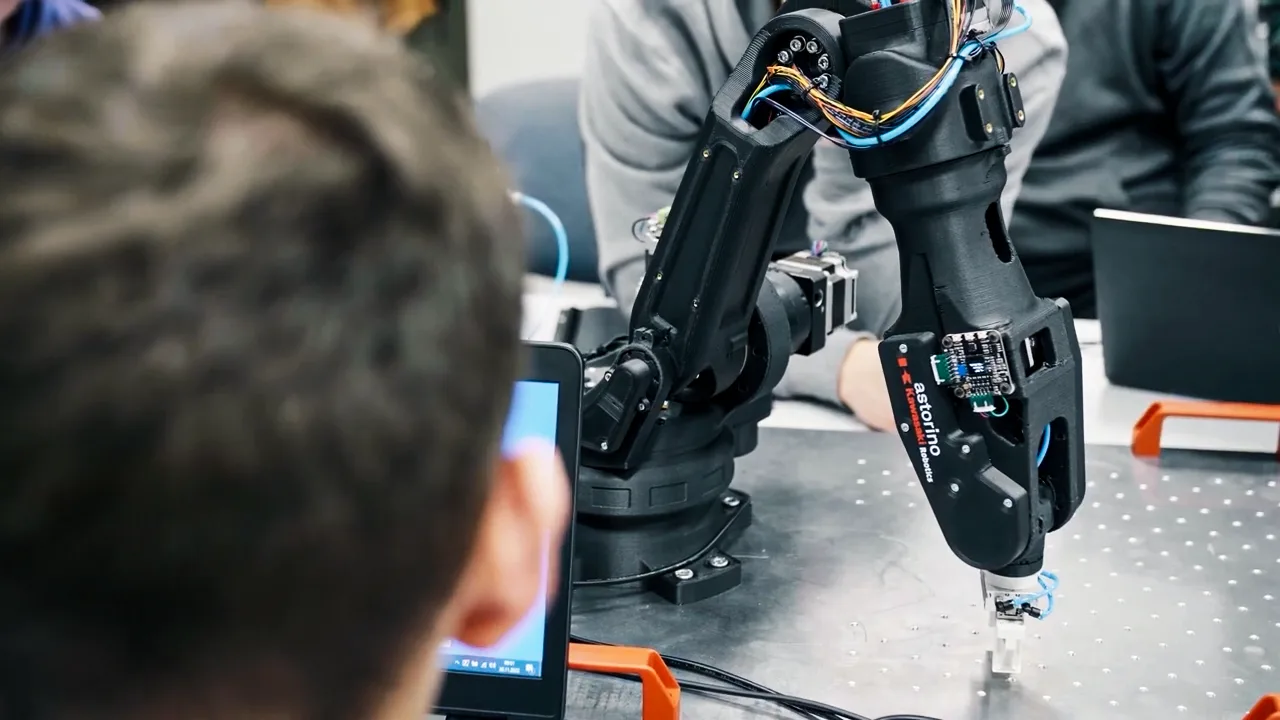
Kawasaki Robotics (USA), Inc. announced Astorino on August 21, 2024 as a robotics education platform for industrial and technical education providers. Its first presentation was scheduled for the 2024 IMTS Smartforce Student Summit in Chicago from September 9 to 14, at Kawasaki Robotics’ booth 121415. The platform is aimed at schools building industrial robot, cobot or automation courses, with hardware and programming designed to resemble Kawasaki’s industrial robot family.
Source statements
Astorino is built around a six-axis robot. Kawasaki describes its structure and programming environment as almost identical to those of an industrial Kawasaki robot, creating a direct teaching path for motion programming and controller workflows. The published specifications also set clear limits: the robot has a 1 kg payload and a total weight of 12 kg.
Newsroom analysis
A compact platform for motion, sensing and I/O lessons The system uses a 110 V outlet and includes an integrated control system, dedicated firmware and software. It communicates over Modbus TCP and USB/Ethernet, giving instructors a way to connect lessons about robot motion with industrial-style communication and control workflows. Astorino’s safety list includes an E-Stop and safety brakes. Motor control uses three signals—pulse, direction and enable—which provides a concrete way to explain how commands and safe stops connect at the hardware level. These are platform functions, however, rather than a blanket claim that every installation is safe for people to work beside. Kawasaki’s announcement does not provide a site-specific risk assessment or claim collaborative operation. Precision and integration options extend the coursework beyond isolated arm movement. Kawasaki says steel gears keep mechanical backlash below five minutes of arc. Astorino can be paired with three gripper types, a 24 V input-output module, a cube dispenser with optical sensors and external sensors. Those additions support pick-and-place exercises involving sensing and I/O, without establishing production throughput or autonomous operation. The cost and support model The announced base price is $5,000. Students can print replacement parts for 99% of the robot from supplied STL files, while the development environment includes free software and a free code editor. Kawasaki said it was developing course materials and Train-the-Trainer training when Astorino was announced. For an institution, that support path is therefore part of the platform’s practical value alongside the arm, controller and accessories. Astorino’s clearest proposition is continuity: learners use a six-axis system whose structure and programming resemble Kawasaki’s industrial robots, but at a defined educational scale. The trade-off is just as important. A 1 kg training platform with listed safety functions can support classroom instruction, yet the announcement does not establish production performance or approval for a specific collaborative workcell. For schools, Astorino is a measurable teaching platform—not evidence that classroom specifications alone settle an industrial deployment. Official sources Official source: kawasakirobotics.com Related reading Amazon Millionth Robot Deepfleet Fleet Software Safety Nasa 2026 Lunabotics Challenge Lunar Field Robot Development