Confirmed facts
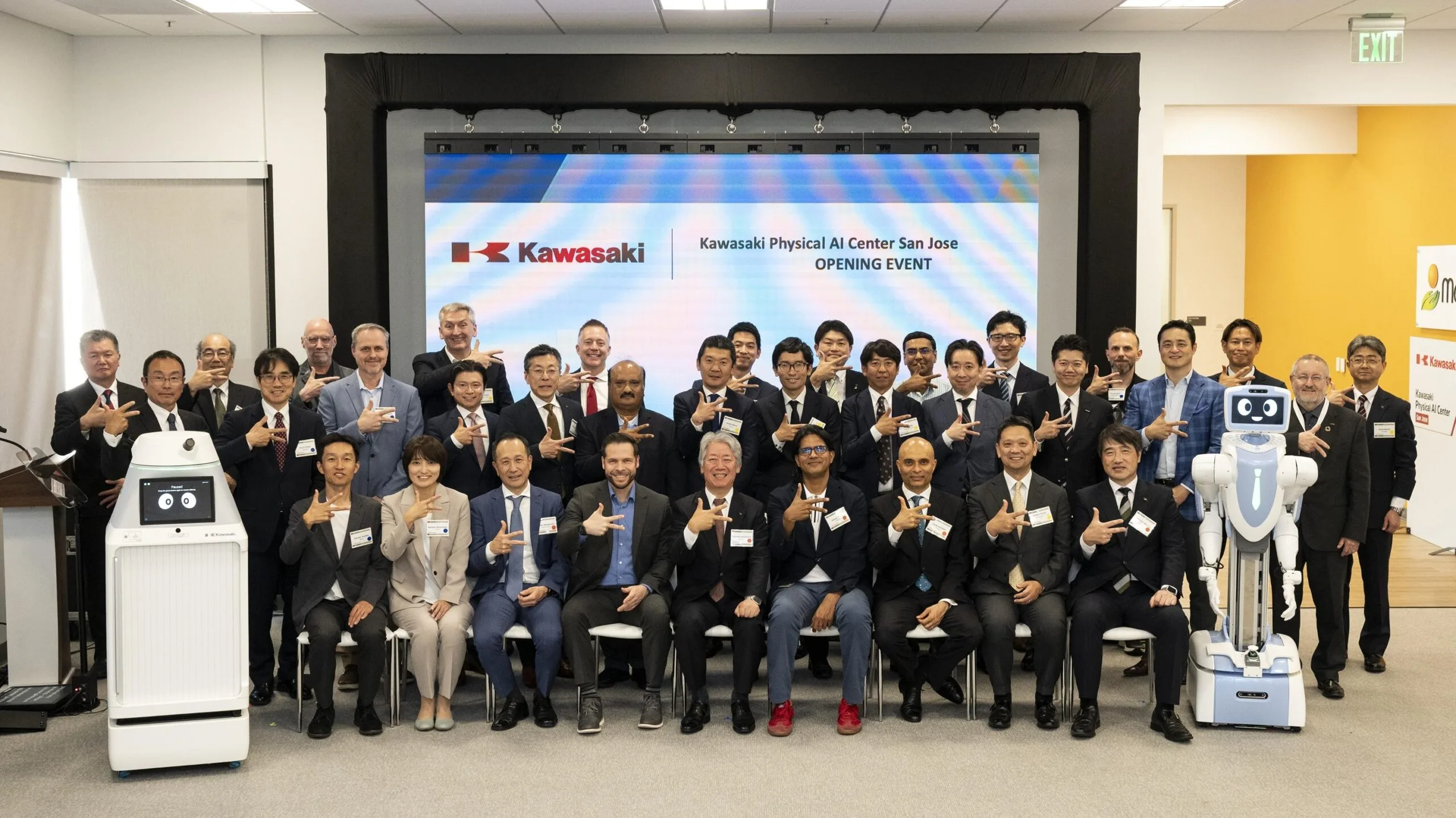
Kawasaki Heavy Industries announced on May 22, 2026, that it had opened the Kawasaki Physical AI Center San Jose. The new base is intended to move Physical AI from research and proof-of-concept work toward practical deployment, with initial attention on healthcare and elder care and additional plans for semiconductor, automotive and mobility applications.
Source statements
That makes the announcement relevant to industrial robotics teams, but its evidence needs to be read carefully. Kawasaki has announced a development hub and a collaboration framework. It has not announced a production robot rollout, a named factory customer, a validated cycle-time result or a safety acceptance test.
Newsroom analysis
What Kawasaki is actually building The center is designed as a co-creation site linking Kawasaki’s industrial and operational knowledge with technology from NVIDIA, Analog Devices, Microsoft and Fujitsu. Kawasaki says the partners will work on AI, sensing, voice recognition, cloud and business-system integration. The stated goal is to develop systems that can perceive real environments, reason about tasks and act through robotic machinery. Healthcare is the first stated focus. Kawasaki describes a potential hospital solution spanning arrival, examination, diagnosis, treatment, surgery and post-care. That is a broad systems ambition rather than a description of one deployable robot. The same announcement also names semiconductor and automotive applications, where repeatability, traceability, integration with existing equipment and controlled operating envelopes are usually more important than a convincing demonstration. What industrial operators can verify today The verifiable facts are limited but useful. The center is located in San Jose, California. Its activity is described as advancing the practical implementation and social deployment of Physical AI. Kawasaki also says it will connect the new US base with domestic development locations in Japan and its European innovation center in Strasbourg, which began operations in March 2026. Those facts establish an infrastructure commitment, not a measurable robot capability. The announcement does not specify a robot model, payload, reach, cycle time, positioning accuracy, intervention rate, network latency, operating temperature or expected availability. It also does not identify a production line where the announced systems are already running continuously. For buyers and integrators, this distinction matters. A development center can shorten the path from a customer problem to a proof of concept, but it does not remove the engineering work required to turn a prototype into a production cell. The announcement is therefore best understood as a signal about Kawasaki’s development direction, not as evidence that general-purpose Physical AI is ready to replace established industrial automation. Safety is a stated objective, not a completed validation Kawasaki says the center’s purpose is to support human judgment and action safely and efficiently. That is a sensible deployment objective, especially in hospitals and factories where robots may share space with workers, patients or maintenance personnel. However, the announcement does not publish a hazard analysis, safety-function architecture, protective separation assumptions, validation procedure or certification result for any future system. Physical AI also introduces operational questions beyond the robot arm itself. A system that changes its behavior based on camera input, voice instructions or cloud-connected models must be evaluated for perception errors, ambiguous commands, unexpected objects, loss of communications and recovery after a stop. In a production environment, the safe state, restart procedure and responsibility for approving a new task must be defined before the system is allowed to operate around people. This does not make the center’s work unimportant. It clarifies what the next evidence should look like: a named task, a defined operating envelope, repeatable performance data, documented failure handling and a site-specific risk assessment. Without those elements, “safe deployment” remains a goal rather than a verified property. Why the hub still matters for cobots and industrial robots The most significant promise is not a new robot specification. It is the attempt to connect industrial robot control with richer perception and decision-making. In principle, that could help robots handle variable parts, deformable materials or changing instructions that are difficult to manage with fixed rules. It could also make it easier for integrators to combine robots with cameras, production software and hospital or factory information systems. The trade-off is that flexibility can make validation harder. A conventional program has a bounded sequence of motions and inputs. An AI-enabled system may be more adaptable, but its behavior must be tested across more combinations of objects, lighting, human presence and task instructions. For a cobot cell, a change in software or end effector can alter speed, force, reachability and contact risk even when the arm itself is unchanged. Industrial teams should therefore watch for deployment evidence rather than broad claims. Useful future disclosures would include the application being automated, the number of operating hours, the percentage of successful cycles, the frequency of human intervention, the conditions under which the system stops and the process used to approve updates. Those measurements would show whether the center is producing repeatable factory systems rather than isolated demonstrations. The practical reading of Kawasaki’s announcement Kawasaki has made a credible organizational move: it has created a US base dedicated to turning Physical AI research into fielded solutions and has named partners covering compute, sensing, software and industrial know-how. That is meaningful for manufacturers exploring flexible automation, but it is not a promise of immediate availability or a substitute for a system integrator. For now, the safest conclusion is narrow. The San Jose center may improve Kawasaki’s ability to develop and localize AI-enabled robotic systems, while the capabilities, limits and safety case of those systems remain to be demonstrated. Companies considering future pilots should ask for task-level benchmarks and validation records before treating the announcement as proof of production readiness. Official sources Official source: kawasakirobotics.com Related reading Nvidia Sim To Real Research Field Robot Developers Nasa Astropix Orbital Robotics Demo Test