Confirmed facts
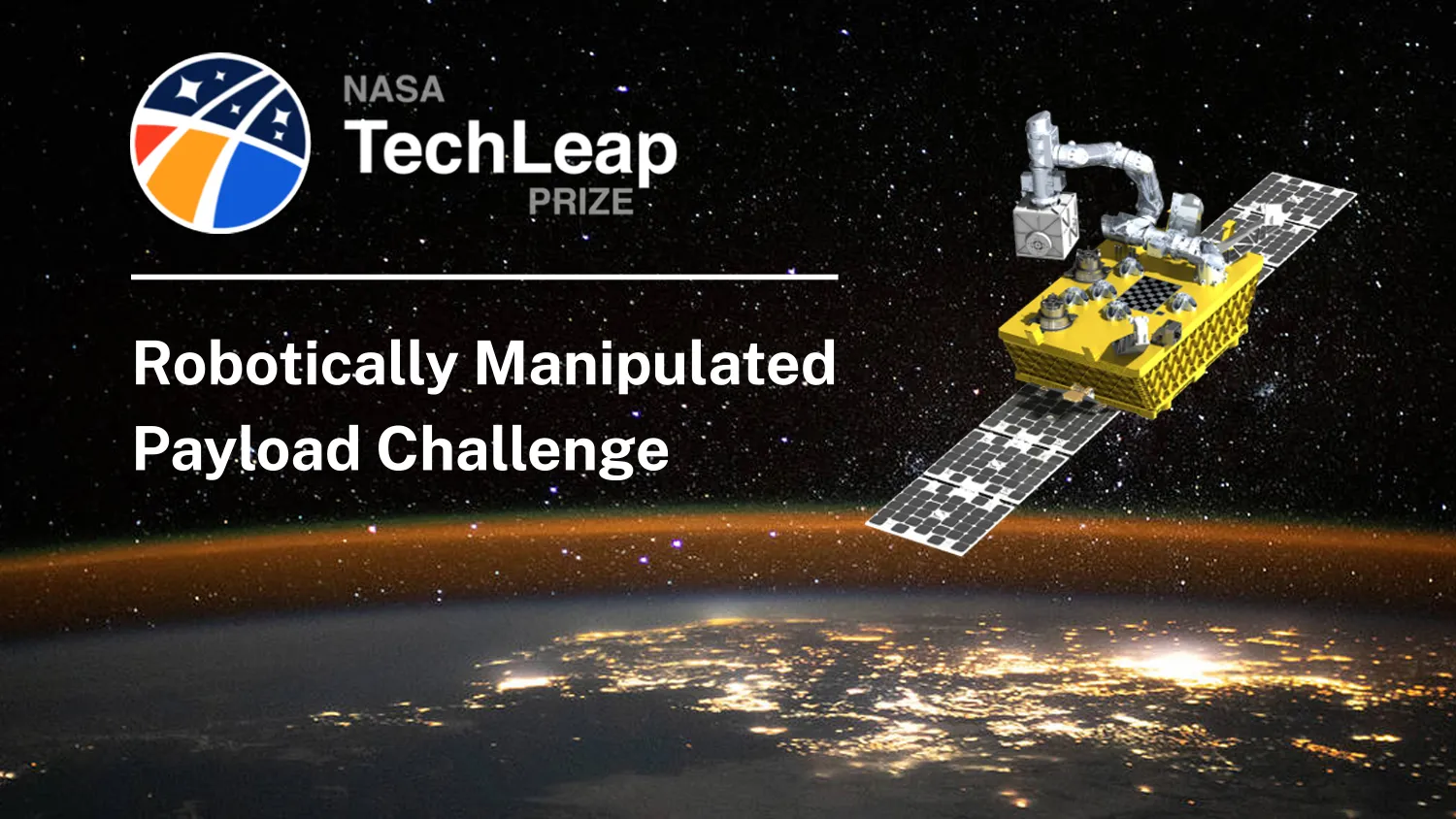
NASA has moved its latest orbital-robotics call from an open application window into the evaluation stage. On the agency’s TechLeap Prize information page, the Robotically Manipulated Payload Challenge is marked closed. NASA says it launched on May 20, 2026, and that applications were due on August 12. The update is useful because it defines a concrete research brief, but it is not evidence that a new robot has already serviced hardware in orbit.
Source statements
What the challenge asks
Newsroom analysis
The target is not a general-purpose robot or a consumer product. NASA invited teams to propose payloads that can interact with, be manipulated by, or be reconfigured by a robotic arm in low Earth orbit. The agency lists robotic inspection, structural assembly, sensor deployment, material processing, and modular systems that can be swapped or upgraded as possible applications. That wording places the payload at the centre of the experiment. A team must propose something that gives an orbital manipulator a meaningful, repeatable task: a component to grasp, a structure to assemble, a sensor to deploy, or a material process to perform. The research question is therefore broader than whether an arm can move from one point to another. It is whether a spacecraft can host useful robotic work through interfaces and tasks that have been designed for manipulation. NASA’s public announcement does not define one universal connector, mass limit, force limit, grasp envelope, or success metric for every proposal. That absence is important. The challenge should not be read as a new robotics standard, and the word “reconfigurable” does not by itself establish that a payload will be safe, autonomous, or reusable. Those properties would need to be specified and verified for each selected experiment. Why this is research, not a product launch TechLeap is managed by NASA’s Flight Opportunities program. The agency describes it as a series of challenges intended to identify and develop space technologies around specific shortfalls. Qualified commercial businesses, academic institutions, entrepreneurs, and other innovators can apply; the program combines a cash prize with an opportunity for a flight test through a commercial provider. For an open-robotics reader, the interesting part is the experiment architecture. In-space servicing, assembly, and manufacturing require more than a capable arm. They require a payload with known attachment points, procedures that can be commanded and checked, and a way to tell whether an operation succeeded. This creates a research interface between robot control, spacecraft design, mission operations, and verification. It also makes the task legible to multiple teams rather than tying the work to one closed product stack. NASA says that up to three winners are to be selected in September 2026. Each may receive up to $500,000 to develop a flight-ready payload, with the opportunity for an orbital demonstration at no additional cost. The agency’s page says the payloads are slated to fly aboard an orbital spacecraft that will rendezvous with the planned Fly Foundational Robots spacecraft; it places that demonstration in early 2028. These are program plans, not completed milestones, so the dates should be reported as targets. How to read the evidence A disciplined reading of the announcement separates four layers. First is the requirement: the proposed payload must be suitable for interaction with a robotic arm in low Earth orbit. Second is the engineering article: the selected team must turn its proposal into flight-ready hardware. Third is the operational demonstration: a mission must command the arm and payload through a defined task. Fourth is the result: the public record would need to show what worked, under which conditions, and with what interventions. NASA has published the first layer and outlined the path toward the other three. It has not yet published selected-payload performance data, an orbital success rate, a completed manipulation sequence, or a comparison with a terrestrial baseline. It would therefore be an overstatement to describe the challenge as proof that routine satellite repair is ready. The announcement supports a narrower conclusion: NASA is opening a structured route for researchers to propose and eventually test robotic payload interactions in orbit. The same distinction applies to safety. The page does not claim a universal certification scheme or a fully autonomous operating mode. A credible future report will need to explain how commands are validated, how contact forces and unexpected motion are handled, what the operator can see, and what happens when a task cannot be completed. It should also state the supervision model and the recovery procedure before presenting a successful demonstration as evidence of deployability. What to watch next The next checkable milestone is NASA’s planned September selection. After that, useful reporting should focus on the selected payloads’ interfaces, operating envelopes, ground-test protocols, telemetry, failure cases, and human-supervision requirements. The orbital dates are also worth tracking, but a launch or rendezvous alone would not prove that a manipulation task succeeded. The decisive evidence will be a published task description followed by mission data that makes the result reproducible and its limits visible. Bottom line: NASA’s Robotically Manipulated Payload Challenge is a timely research signal about how orbital infrastructure might be designed for robotic work. It is not a product launch, a safety standard, or a completed in-space result. Its value today is the testable question it puts on the table: can payload designers make future orbital hardware accessible to robots in a way that can be commanded, verified, and eventually repeated? Official sources Official source: nasa.gov Official source: nasa.gov Related reading Digit Safety Check Humanoid Deployment Context Comau Mr4weld Mobile Welding Shipyard Deployment Limits