Confirmed facts
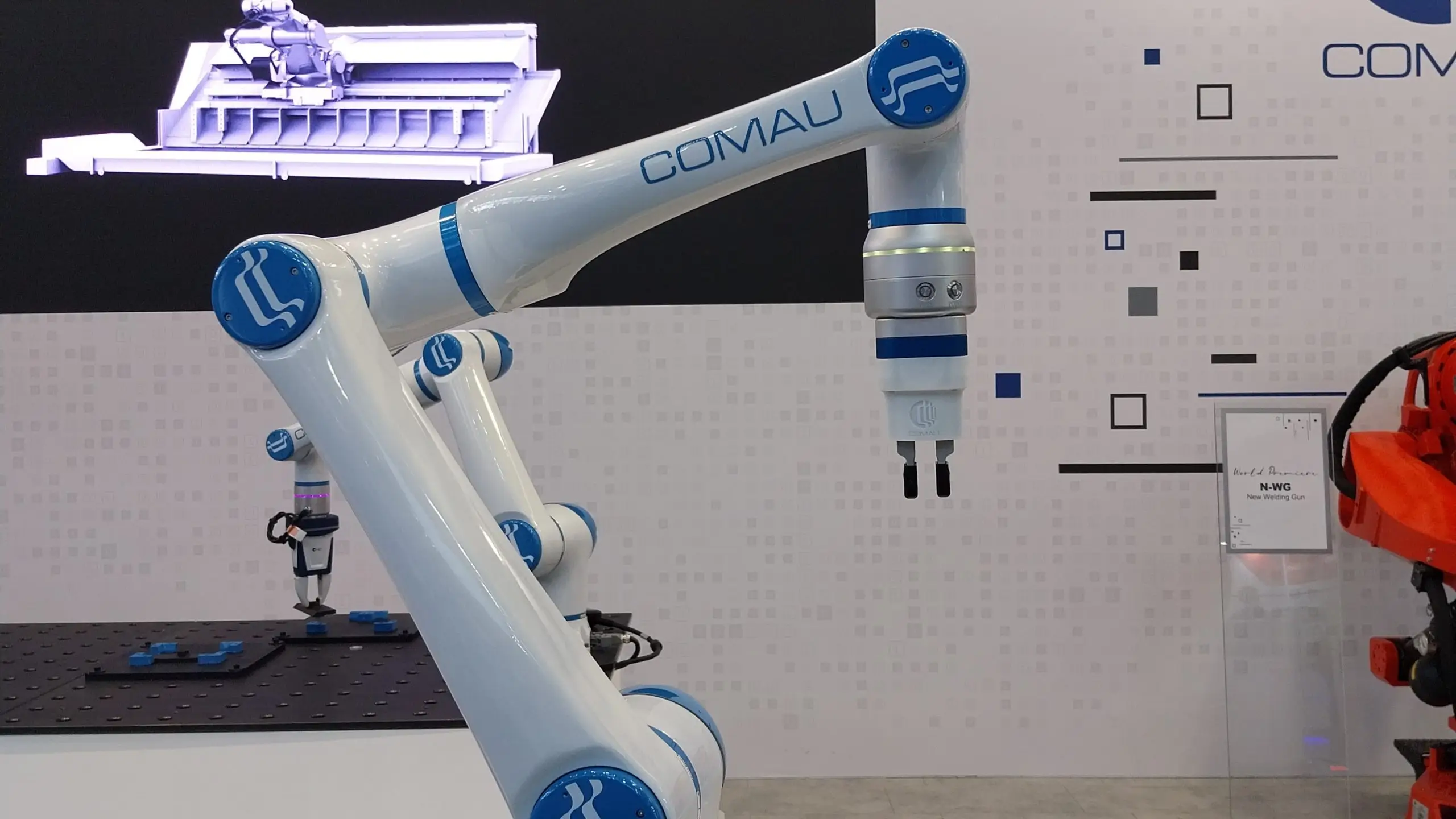
Comau is moving its MyCo collaborative robots beyond a product launch and into a European project focused on reconfigurable industrial work. In its official CONVERGING project release, the company describes two prototype applications: collaborative post-processing of additively manufactured parts and remote, non-invasive inspection of aircraft wings.
Source statements
The update matters because it places a cobot in tasks where deployment conditions are more demanding than a standard pick-and-place demonstration. The work involves human operators, autonomous guided vehicles, artificial intelligence and robotic systems operating within flexible production environments. It also gives manufacturers a clearer basis for judging what has been demonstrated, and what remains to be proven.
Newsroom analysis
What Comau says the prototypes do The first Comau-led deliverable uses a medium-payload MyCo cobot for post-processing parts made by additive manufacturing. The stated objective is to combine human-safe operation with the precision and adaptability needed in advanced production. The release does not identify the exact MyCo model, tooling, process material, cycle time or measured surface-finish result. The second pilot is aimed at aerospace maintenance. Comau says it developed a collaborative remote-inspection robot for aircraft-wing inspection, traditionally performed manually. The system uses a six-axis MyCo cobot with precision mechanics, advanced kinematics and remote-control capabilities. The announcement presents the concept as non-invasive and intended to improve inspection accuracy and safety, but it does not publish an accuracy percentage, inspection rate, defect-detection result or completed aircraft-maintenance deployment. That distinction is important. Comau says the prototypes were introduced during a project review for testing with partners and European Commission reviewers. This is evidence of project validation activity, not evidence that the system is already operating as a routine production asset at a customer site. Published capabilities and the limits of the numbers Comau’s current MyCo family page lists six models with payloads from 3 kg to 15 kg and reaches from 590 mm to 1,300 mm. Listed repeatability ranges from ±0.02 mm to ±0.05 mm. These are family-level specifications, so they should not be treated as the measured performance of the CONVERGING prototypes. For a concrete reference point, Comau lists the MyCo-10-1.00 with a maximum wrist payload of 10 kg, a 1,000 mm horizontal reach, a robot weight of 43 kg, a tool speed of 2 m/s and repeatability of ±0.03 mm on its model page. The same page identifies six degrees of freedom, floor, ceiling, inclined-plane and wall mounting, and a working temperature range of 0 to 50 °C. These figures help define where a MyCo could fit, but they do not answer the application-level questions that determine whether a deployment is viable. A post-processing task may be limited by tool mass, abrasive loads, part fixturing or dust. Aircraft inspection may be limited by access, surface geometry, sensor integration, remote supervision and the need to verify every inspection result. The robot’s nominal payload is only one part of that system calculation. Safety is a system property Comau presents MyCo as a collaborative platform with built-in safety functions and describes the CONVERGING post-processing prototype as using human-safe operation. The current product information also identifies collaborative operation, force-control integration and ten advanced security configuration functions for the MyCo-10 model. However, the same product information distinguishes between collaborative and non-collaborative operation, and lists high speed in non-collaborative mode. That is a practical reminder that a cobot label does not make every application automatically safe for unrestricted human access. The end effector, workpiece, speed, force, stopping behaviour, layout and operating mode all affect the risk profile. There is also a specification detail that buyers should verify. The 2025 launch release describes IP66 protection for the MyCo family, while the current family page describes IP54 protection as standard with IP66 available as an option. The exact model and configuration therefore need to be confirmed before a facility relies on a particular dust- or water-resistance claim. What manufacturers should ask next For a professional evaluation, the next evidence should come from the application rather than the product headline. Buyers should request the exact MyCo model and end effector, the payload and inertia calculation, the intended collaborative operating mode, the risk-assessment basis, the stopping and contact-limit data, and the inspection or process-quality metrics recorded during the pilot. They should also establish whether the proposed workflow requires guarding, scanners, restricted zones or supervised operation. In additive manufacturing, the surrounding process may create hazards even when the robot arm is collaborative. In aircraft inspection, the inspection instrument, remote-control link and maintenance environment may be more consequential than the manipulator itself. Bottom line Comau’s CONVERGING update is a meaningful industrial robotics announcement because it shows MyCo cobots being developed for additive-manufacturing finishing and aerospace inspection rather than only routine handling. The evidence currently supports prototype testing and a defined technical direction. It does not yet support claims of production-scale throughput, verified inspection accuracy or universal fence-free deployment. For manufacturers, the useful takeaway is to treat MyCo as a configurable platform whose suitability must be demonstrated at the task, tooling and safety-system level. Official sources Official source: comau.com Official source: comau.com Official source: comau.com Official source: comau.com Related reading Nvidia Jetson Edge Ai Field Robot Prototypes Open Robotics 2026 Strategy Software Agenda