Confirmed facts
On May 28, NVIDIA Research published a useful update for teams building robots that must leave the lab: eight papers presented at the International Conference on Robotics and Automation (ICRA) describe how simulation-trained systems are being checked on physical machines. The announcement is not a product launch or a promise that one software stack makes a robot autonomous. Its value is narrower and more practical: it maps a development path from synthetic training to supervised field trials, while showing where the evidence still stops.
Source statements
For developers working on autonomous mobile robots, humanoids or outdoor manipulation platforms, that distinction matters. A field robot faces uneven ground, changing light, clutter, cable snags, moving people and hardware differences that a clean demonstration can hide. NVIDIA's official ICRA report puts those problems in one place and links to the tools behind several of the experiments.
Newsroom analysis
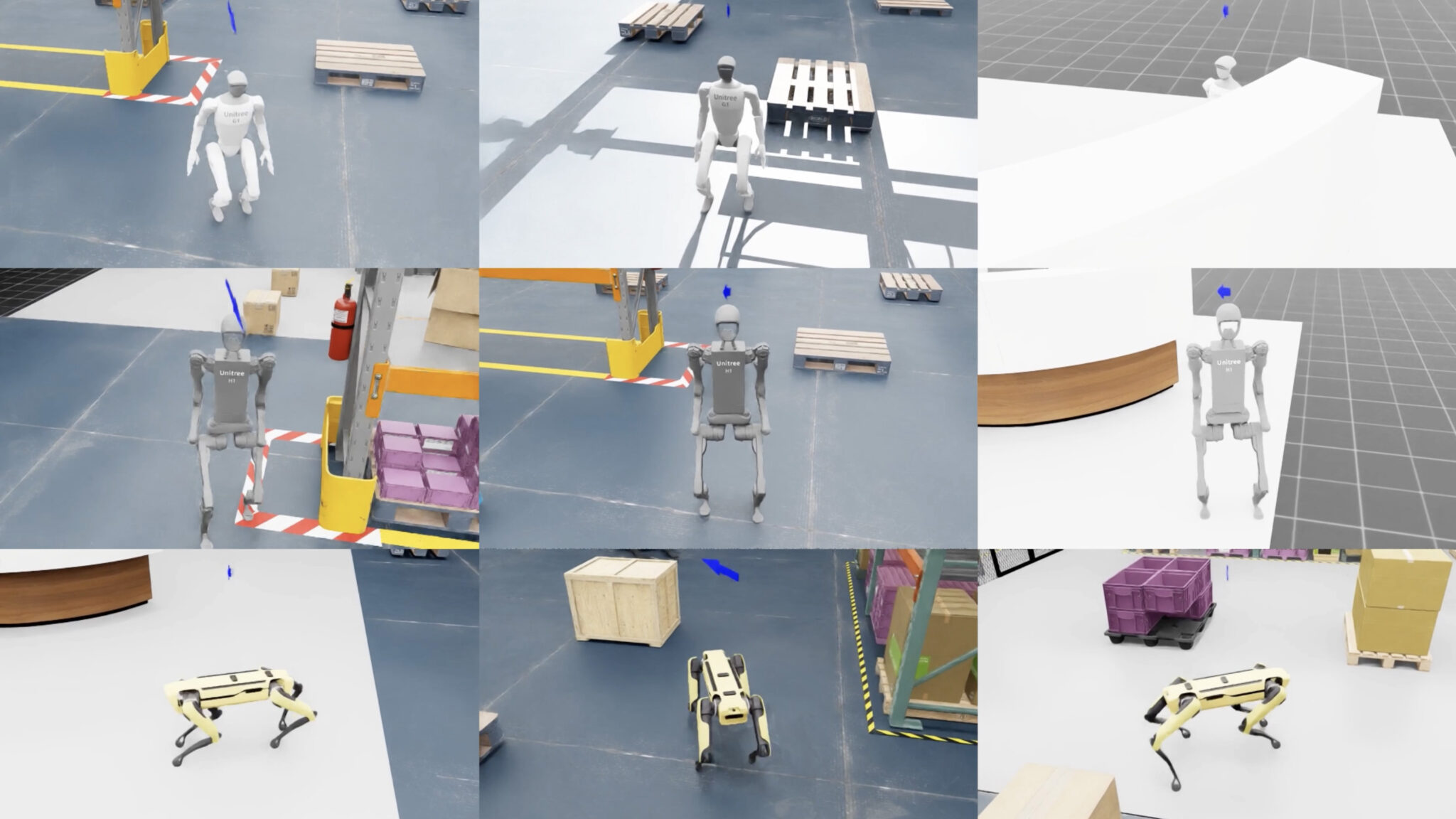
What the research actually demonstrates The clearest platform-level result is COMPASS. NVIDIA says the framework first learns a baseline navigation policy with imitation learning, then uses residual reinforcement learning in Isaac Lab to adapt it to different robot bodies. The training described in the post uses simulation rather than real-world robot data. Against an imitation-learning baseline, COMPASS achieved a 4.5-times improvement in average success rate and transferred to about 80% success across 20 real-world navigation trials on autonomous mobile robots and humanoids. That is encouraging for teams that want to reuse a navigation idea across more than one chassis, but it is not universal interchangeability. A policy still depends on the robot's geometry, sensors, actuator response, compute budget and timing. A new platform needs its own validation, and the reported 20 trials are an evidence point, not a certification of reliable operation in every warehouse, construction site or rural path. Other results are more directly relevant to difficult field handling. Grasp-MPC continuously corrects the final approach to an object instead of executing a fixed grasp. NVIDIA reports roughly 75% overall success on real robots, compared with 41% for a baseline, after training on two million simulated trajectories across 8,000 objects. Deformable Cluster Manipulation addresses a different problem: moving a tangled mass rather than a single clean object. Its motivating example is clearing branches that have grown over a power line. The policy was trained on synthetic trees and, according to NVIDIA, deployed to real branches zero shot, with possible applications in cable management and agricultural inspection. A practical development path, with limits The announcement suggests a four-stage workflow for field robotics teams. First, define the job and its failure boundaries before choosing a model: what counts as a safe stop, what the robot may touch, and which conditions require a human takeover. Second, use Isaac Sim or related open simulation tools to vary terrain, lighting, object shape, sensor noise and starting positions rather than training on one ideal scene. Third, keep navigation, perception and manipulation separable enough to test each subsystem and replace a failed policy without losing the rest of the stack. Finally, replay the policy on the target hardware in a controlled area, compare logs with simulation and expand the operating envelope only when the measured behavior remains within the approved limits. That workflow is compatible with NVIDIA's documented ecosystem, including Isaac Lab, Isaac Sim, the open COMPASS repository and NVIDIA's edge-compute platforms. Compatibility should be read as a starting point, not a plug-and-play guarantee. Teams need to confirm operating-system and driver support, sensor interfaces, clock synchronization, accelerator memory, thermal limits, network behavior and the robot middleware used by the target platform. The source article names Jetson as one hardware example for multi-arm planning, but it does not establish that every field robot or payload will meet the same performance. There is also a less glamorous but essential engineering step: traceability. Record the simulator version, asset assumptions, policy checkpoint, sensor configuration, hardware revision and test conditions for every result. Without that record, a reported success rate cannot be reproduced or meaningfully compared after a camera, gripper, battery or terrain change. Safety comes before the sim-to-real claim Simulation can expose edge cases and reduce the amount of risky trial-and-error, but it cannot approve a live mission. The branch-clearing example is especially high consequence because a power line introduces electrical, access and recovery hazards. A real deployment would need a documented site survey, an exclusion zone, an agreed human supervisor, a positive emergency-stop path, a communications-loss behavior and a recovery plan for entanglement or loss of localization. If work is near energized infrastructure, the responsible asset owner and applicable local rules must determine whether the task is permitted at all. The same principle applies to mobile robots and humanoids. Before increasing speed, payload or autonomy, validate stopping distance, obstacle detection, remote takeover, safe restart and behavior around people on the actual surface and with the actual sensors. A digital twin is useful for rehearsing those cases; it is not evidence that the physical robot complies with workplace or machine-safety obligations. Regulation is jurisdiction-specific, and an outdoor robot, an aerial system and an industrial vehicle can trigger different requirements. NVIDIA's ICRA announcement is therefore best read as a development signal rather than a deployment verdict. It offers field developers concrete building blocks: reusable simulation, embodiment-aware training, adaptive grasping and open code. It also gives them a sensible question to ask of every impressive result: which robot, which environment, which test count and which failure recovery? Until those answers are documented for the target mission, sim-to-real is a promising test path—not permission to remove supervision. Official sources Official source: blogs.nvidia.com Related reading Nasa Astropix Orbital Robotics Demo Test Amazon One Million Robot Network Real Deployment Limits