Confirmed facts
NVIDIA and LG Group announced on June 7, 2026 that they are building an AI-factory platform for robotics, mobility and industrial operations. The collaboration links model development, physical-AI data generation, robot simulation, training, validation, edge deployment and factory-scale digital twins. For robotics developers, the important news is not a new robot model but an attempt to connect the software pipeline around robots that must eventually operate in logistics and manufacturing environments.
Source statements
What LG and NVIDIA actually announced
Newsroom analysis
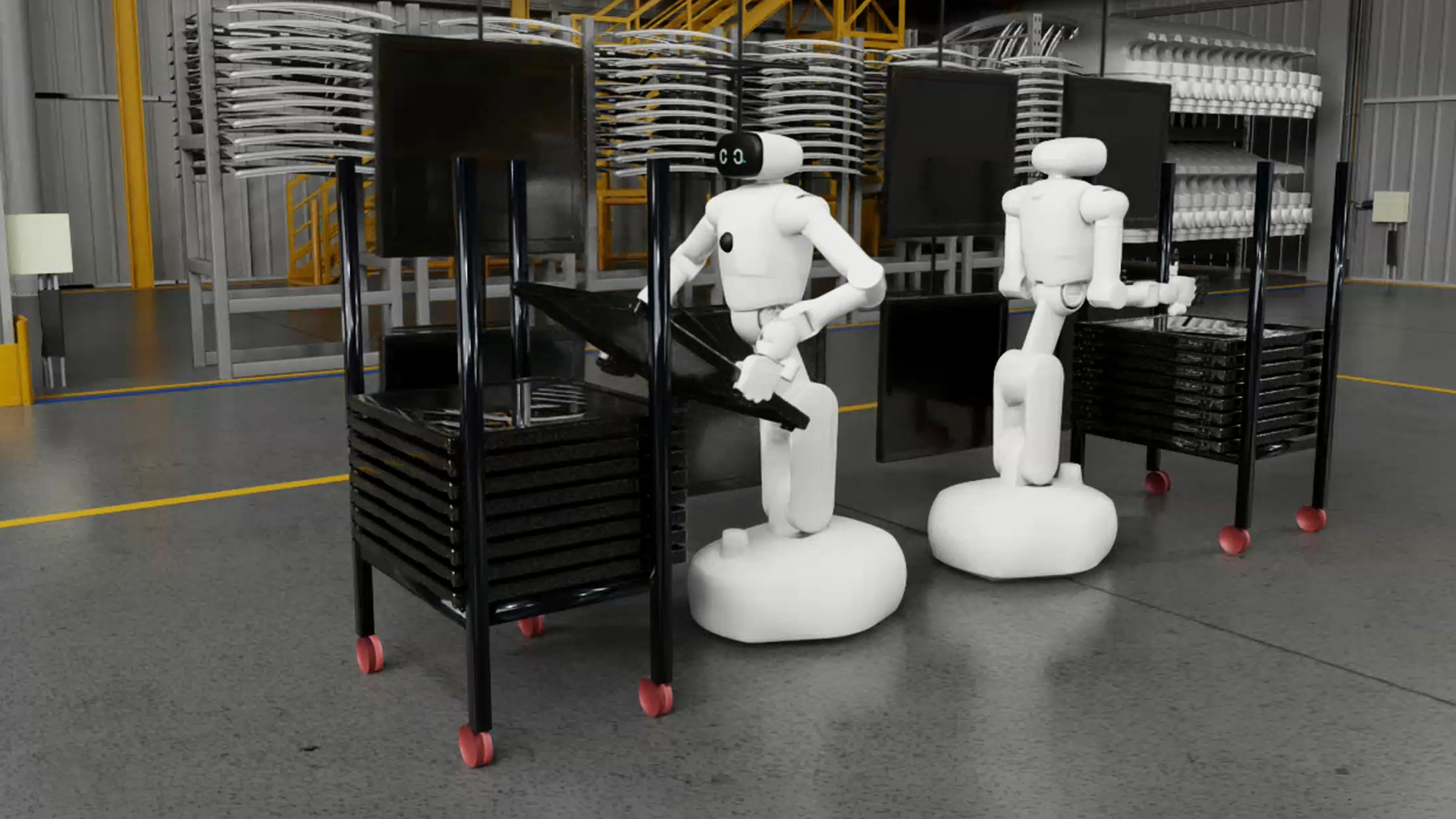
The official NVIDIA announcement describes a joint infrastructure effort rather than a finished product. NVIDIA will provide accelerated computing and robotics software, while LG contributes manufacturing data, robotics expertise, sensing components and industrial deployment channels. LG Electronics is developing home robots such as CLOiD, while LG CNS is building an ecosystem around its PhysicalWorks industrial robot platform for manufacturing and logistics sites. The proposed stack includes NVIDIA Isaac simulation and robot-learning frameworks, Cosmos models for synthetic-data generation and augmentation, and the Isaac GR00T vision-language-action model. LG Innotek also plans to develop sensing solutions optimized for NVIDIA environments and GPU architecture. These elements could give developers a common route from training data to robot behavior, but the announcement does not describe a single integrated robot, a production release, or a completed customer deployment. The development path is the practical news For a mobile robot or other field platform, the value of this architecture is the possibility of repeating the same workflow across simulation and hardware. A team could build virtual scenes, vary objects and operating conditions, train policies, validate perception and motion, then move selected workloads to an edge computer. Digital twins could help compare layouts or traffic flows before changes reach a warehouse or factory floor. That workflow is useful only when the simulated robot, sensors and real platform remain sufficiently aligned. The source announcement says that LG can simulate, train and validate home cobots in physically accurate virtual environments, but it provides no independent validation of transfer accuracy, failure rates or performance outside controlled facilities. The announcement also gives no outdoor trials, weather data, degraded-communications results or recovery statistics for field robots. Compatibility is the next question The collaboration is clearly designed around NVIDIA software and hardware. That creates a defined development direction for teams already using the Isaac ecosystem, but it is not the same as an open interoperability guarantee. The announcement does not specify supported robot models, sensor buses, firmware versions, real-time control interfaces, ROS 2 integration details or the compute targets required for each model. Developers evaluating the platform should therefore ask for a concrete compatibility matrix before treating the announcement as an integration shortcut. The relevant checks include whether a robot's cameras, lidar, inertial sensors and motor controllers can be connected without replacing existing safety-critical components; whether simulation and hardware use the same coordinate frames and timing assumptions; and whether trained policies can be monitored, limited or rolled back on the deployed machine. Safety and regulation remain system work Simulation and synthetic data can expose perception and planning failures before a robot reaches a worksite, but they do not create a safety case by themselves. NVIDIA and LG do not present a robot-level risk assessment, emergency-stop architecture, protective-field design, speed and force limits, cybersecurity plan or conformity pathway in this announcement. Those obligations depend on the complete machine, its attachments, its operating environment and the jurisdiction in which it runs. For logistics and manufacturing, that means the platform layer must remain subordinate to validated controls for human presence, collision avoidance, loss of localization, sensor occlusion, network interruption and safe recovery. For outdoor or field deployment, teams would additionally need to address weather, dust, uneven terrain, GNSS degradation, radio coverage, bystanders and remote supervision. None of those conditions is validated by the partnership announcement. A digital twin can support the evidence package; it cannot replace commissioning tests, operator training or the applicable local compliance review. What is real and what remains a plan The real deliverable today is the announced collaboration and its stated software direction. LG is developing robotics workflows around NVIDIA tools, and LG CNS is building an industrial platform intended for manufacturing and logistics. The source does not report throughput, uptime, incident reduction, production availability or a completed field deployment. It also does not give a timetable for the promised reference robots or quantify the benefits of synthetic data for a deployed robot. That distinction matters for buyers and developers. The NVIDIA-LG announcement is useful as a roadmap for teams deciding whether a simulation-to-edge architecture matches their existing tools and data. It is not evidence that a robot can safely operate in a new site, nor is it a substitute for a platform-specific compatibility review. The strongest near-term use is architectural: test the data and simulation workflow first, then require hardware, safety and regulatory evidence before allowing autonomy onto a real floor or field. Official sources Official source: blogs.nvidia.com Related reading Nasa Rsgs Launch In Space Robot Servicing Test Apollo 2 Robot Park Real Work Not Finished Humanoid