Confirmed facts
NASA’s July 21 launch of the Robotic Servicing of Geosynchronous Satellites (RSGS) mission is a useful robotics story because the payload is tied to a defined engineering task: inspecting and upgrading satellites in geosynchronous Earth orbit. The official NASA announcement confirms that the Mission Robotic Vehicle, carrying RSGS, is now en route to orbit after launch aboard a SpaceX Falcon 9. It does not, however, report a completed servicing operation or establish routine autonomous maintenance.
Source statements
What the launch actually puts in orbit
Newsroom analysis
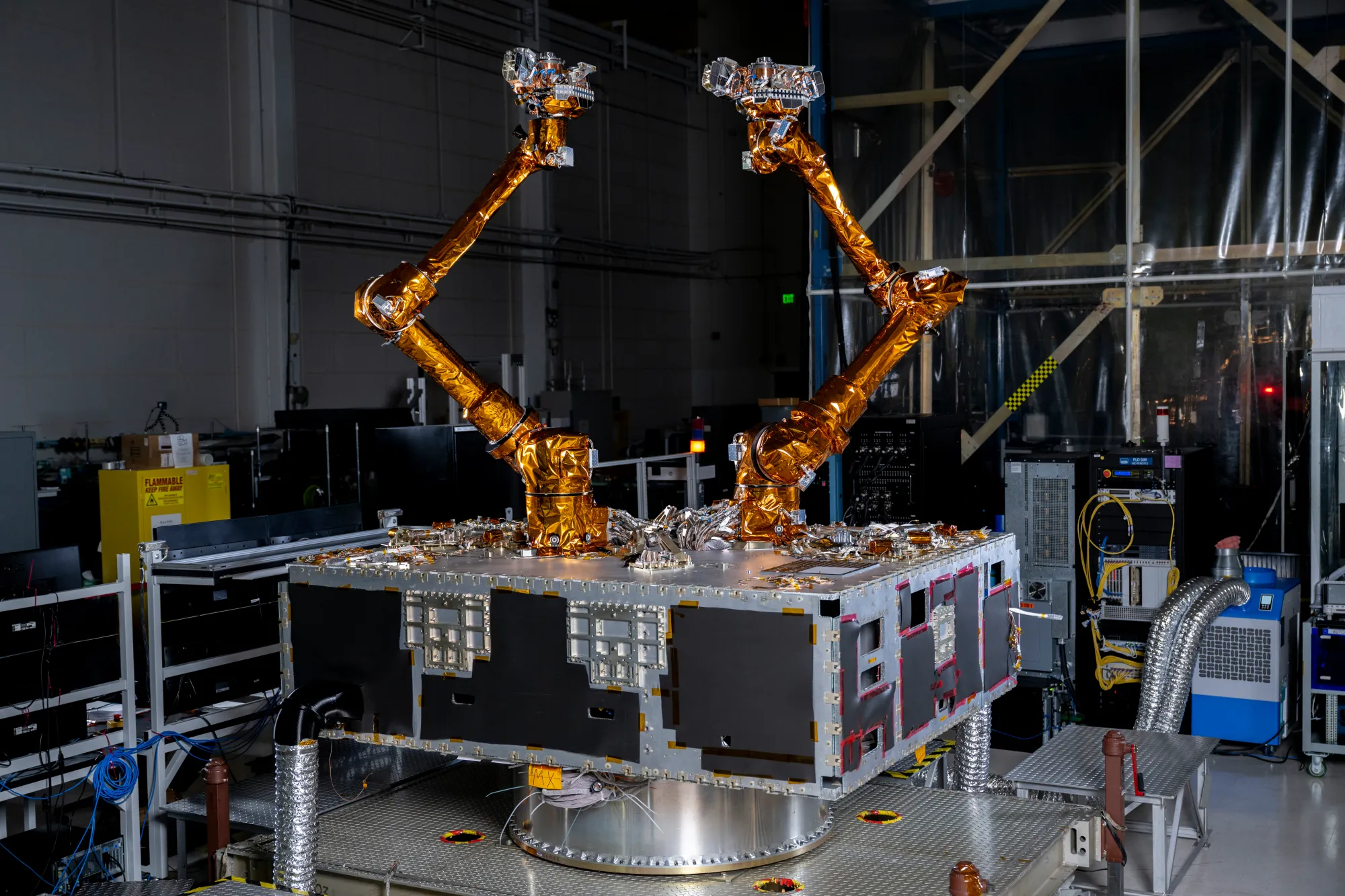
RSGS is funded by the Defense Advanced Research Projects Agency and uses twin dexterous robotic arms developed by the U.S. Naval Research Laboratory. DARPA provided the robotic arm assembly for integration onto Northrop Grumman’s Mission Robotic Vehicle, described by NASA as a multi-mission in-space servicer. The intended work is specific. The spacecraft is designed to inspect and upgrade satellites by installing small propulsion modules known as mission extension pods. In principle, that could extend the useful life of spacecraft that remain operational but face fuel constraints or obsolete equipment. NASA says hundreds of satellites occupy geosynchronous orbit, making servicing relevant to communications, weather and other infrastructure. The announcement describes the mission’s purpose and architecture; it does not provide a flight performance result. The research is in the verification chain The most important detail for robotics engineers is not the launch vehicle but the supporting work required before and during the mission. NASA’s role includes dynamic simulation and analysis tools, software analysis for performance verification, and a team of flight robot operators who will support technically demanding procedures in orbit. That combination shows how high-consequence robotics is normally evaluated. A manipulator cannot be treated as an isolated arm: its motion has to be modelled alongside the spacecraft, the target satellite, communications constraints and the procedure being executed. Simulation can expose timing, geometry and collision risks before a command reaches flight hardware. Software verification can check whether the implemented behaviour matches the approved operation. Human operators remain part of the control loop when the task is too consequential for an unexamined autonomous response. NASA’s RSGS project overview places the programme within technology development, integration, testing and demonstration. It also says NASA is contributing expertise in space robotics, systems engineering, integration, operator training and spaceflight operations. Those categories are a reminder that a research result becomes a field capability only after the surrounding procedures, interfaces and recovery plans are credible. Why satellite servicing is a hard robotics problem On Earth, a robot can often rely on a prepared fixture, a known floor and a technician who can intervene directly. In geosynchronous orbit, the robot must work around a moving target without the same physical access or margin for trial and error. The task involves rendezvous, inspection, capture or close approach, manipulation and the safe execution of a service procedure. Each stage creates opportunities for sensing errors, unexpected contact or loss of the planned configuration. NASA’s broader robotic servicing research explains why these systems are being developed for inspection, servicing, assembly and other in-space operations. It also connects current work to earlier NASA and DARPA investments in motion control, robotic software frameworks, force-torque sensing and flight operations. That heritage is relevant context, but it should not be confused with a result from the newly launched RSGS mission. What the announcement does not prove The verified record supports a launch, a defined robotic payload, NASA technical support and a planned servicing demonstration. It does not yet establish that RSGS has inspected a satellite, installed a mission extension pod, completed a grapple, or operated without human supervision. It also gives no public price, throughput figure, servicing schedule or reliability percentage. This distinction matters because a spacecraft can be flight-ready without every operational capability being demonstrated in orbit. The useful next evidence will be mission updates describing commissioning, proximity operations, robotic-system checks and any servicing milestone in enough detail to separate planned capability from observed performance. Safety and evidence discipline RSGS is not a consumer robot and this article is not an operating guide. Its safety case belongs to mission engineering, approved procedures, simulation, verification and trained flight personnel. For readers evaluating similar research, the practical method is straightforward: identify the task, separate tested behaviour from intended behaviour, record who remains responsible for supervision, and wait for mission evidence before calling a capability deployed. RSGS therefore matters less as a promise of fully autonomous orbital maintenance than as a live test of the complete robotics stack around servicing: hardware, simulation, software verification, operator training and flight operations. That is the level at which the mission can be assessed today. Official sources Official source: nasa.gov Official source: etd.gsfc.nasa.gov Official source: nasa.gov Related reading Apollo 2 Robot Park Real Work Not Finished Humanoid Ur8 Long Long Reach Limits Factory Deployment