Confirmed facts
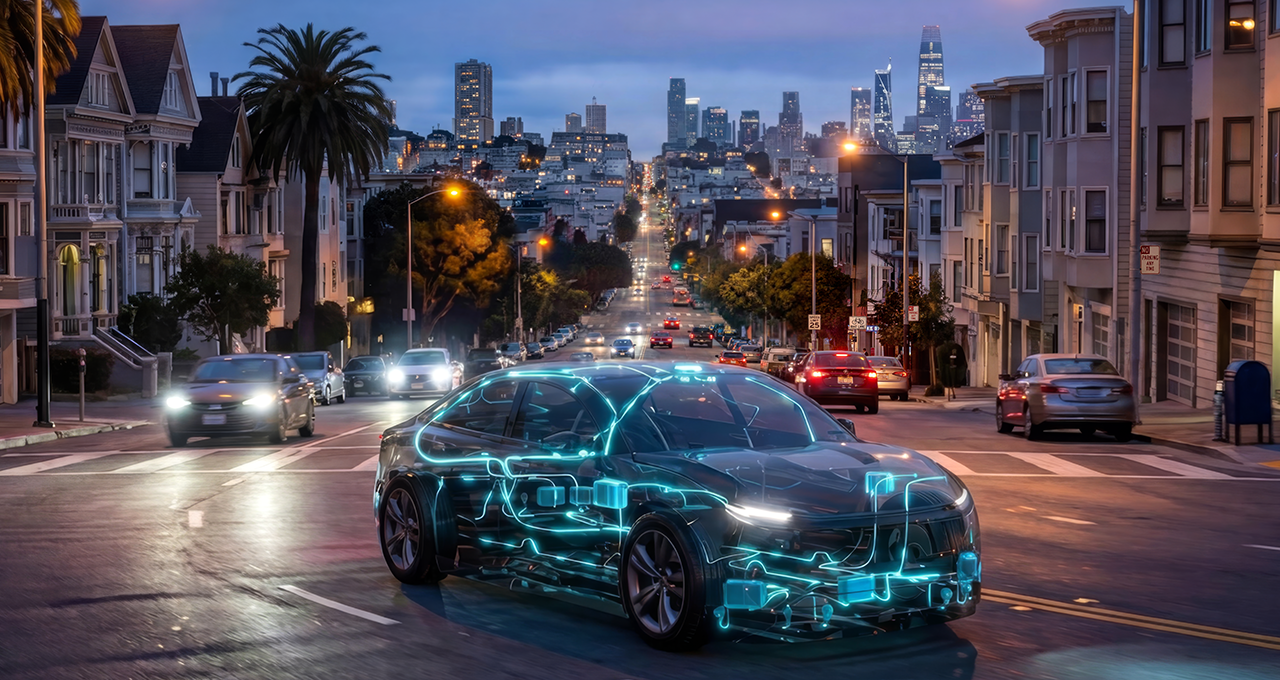
NVIDIA is presenting Halos OS as a production-ready foundation for AI-driven vehicles built on NVIDIA DRIVE Hyperion. The platform covers the development path from training and simulation in Halos Infra to onboard inference in the vehicle, with safety controls integrated below the application layer.
Source statements
Compatibility across sensors and vehicles
Newsroom analysis
Halos SDK is designed for teams that need to move a driving stack between different vehicle configurations. Its sensor abstraction layer separates autonomous-driving software from individual sensor drivers. A sensor can therefore be added or replaced without requiring changes throughout the application code. A second abstraction layer connects the driving stack to the rest of the vehicle through a consistent interface. The goal is to reduce the software impact of hardware changes as vehicle designs and fleet configurations evolve. That does not remove the integration work, but it gives deployment teams a defined way to contain it. NVIDIA also says Halos Core provides certified support for CUDA and TensorRT, alongside the open-source TensorRT Edge-LLM framework for running large language models at the edge. These components place the platform within NVIDIA’s broader software and hardware ecosystem rather than limiting it to a single vehicle design. Safety functions stay below the AI applications Halos Core is the certified base of Halos OS and the next generation of NVIDIA DriveOS. NVIDIA says the platform has been audited and documented for predictable behavior during failures, with compliance at ASIL D under the ISO 26262 automotive safety standard. A Halos Core hypervisor isolates safety-critical functions so a failure cannot reach vehicle controls. Above that layer, Halos Applications adds AI guardrails through deterministic, rule-based functions intended to operate within defined limits. This division leaves room for AI systems while keeping selected safety behavior bounded and predictable. The architecture addresses a central problem in automated driving: an AI stack must handle complex situations, while some responses need to remain governed by predefined safety behavior. The platform’s safety claims describe that architecture and its evaluation framework; they do not by themselves establish how a complete vehicle will perform in every operating environment. Robotaxi programs are part of the roadmap Halos OS is being presented alongside announced robotaxi programs, not as a consumer-ready vehicle. Uber and Autobrains are launching a robotaxi program in Munich on NVIDIA DRIVE Hyperion, using Autobrains’ agentic AI. Foxconn is also expanding its collaboration with NVIDIA to deploy robotaxi fleets in Taiwan by combining its services with DRIVE Hyperion. NVIDIA’s Halos Safety Evaluation Framework is intended to help teams build a safety case across the range from Level 2 driver-assistance systems to Level 4 robotaxis. NVIDIA says the framework draws on more than 330 research papers and 1,000 patents developed in Halos OS. What deployment teams should take from it The immediate change is architectural. Sensor and vehicle interfaces are designed to reduce the code impact of hardware changes, while safety functions are separated from the applications and evaluated across development stages. That combination could make a platform easier to adapt as fleets and vehicle designs change. However, ASIL D compliance and ISO 26262 claims do not, on their own, establish permission to operate a robotaxi in Munich, Taiwan or any other jurisdiction. Operators still have to address local deployment requirements separately. Halos OS is therefore most relevant as infrastructure for teams preparing safety-critical AI vehicles. It combines development, simulation, inference and failure handling in one platform, but the compromise remains: software compatibility can simplify integration without removing the operational and regulatory work required before a fleet runs in public. Official sources Official source: blogs.nvidia.com Related reading Boston Dynamics Stretch Real Warehouse Work Clear Limits Kawasaki Astorino Industrial Robot Training Classrooms