Confirmed facts
Amazon’s next-generation Proteus arrived with a large headline: a planned €10 billion investment in its European fulfillment network. The robotics detail is more measured. In its official June 4, 2026 announcement, Amazon says the new mobile robot is still being piloted in its labs. Deployment in Europe is planned for the first half of 2027. That makes Proteus a useful case study in how to separate an operating deployment from a forward-looking expansion.
Source statements
What is operating today?
Newsroom analysis
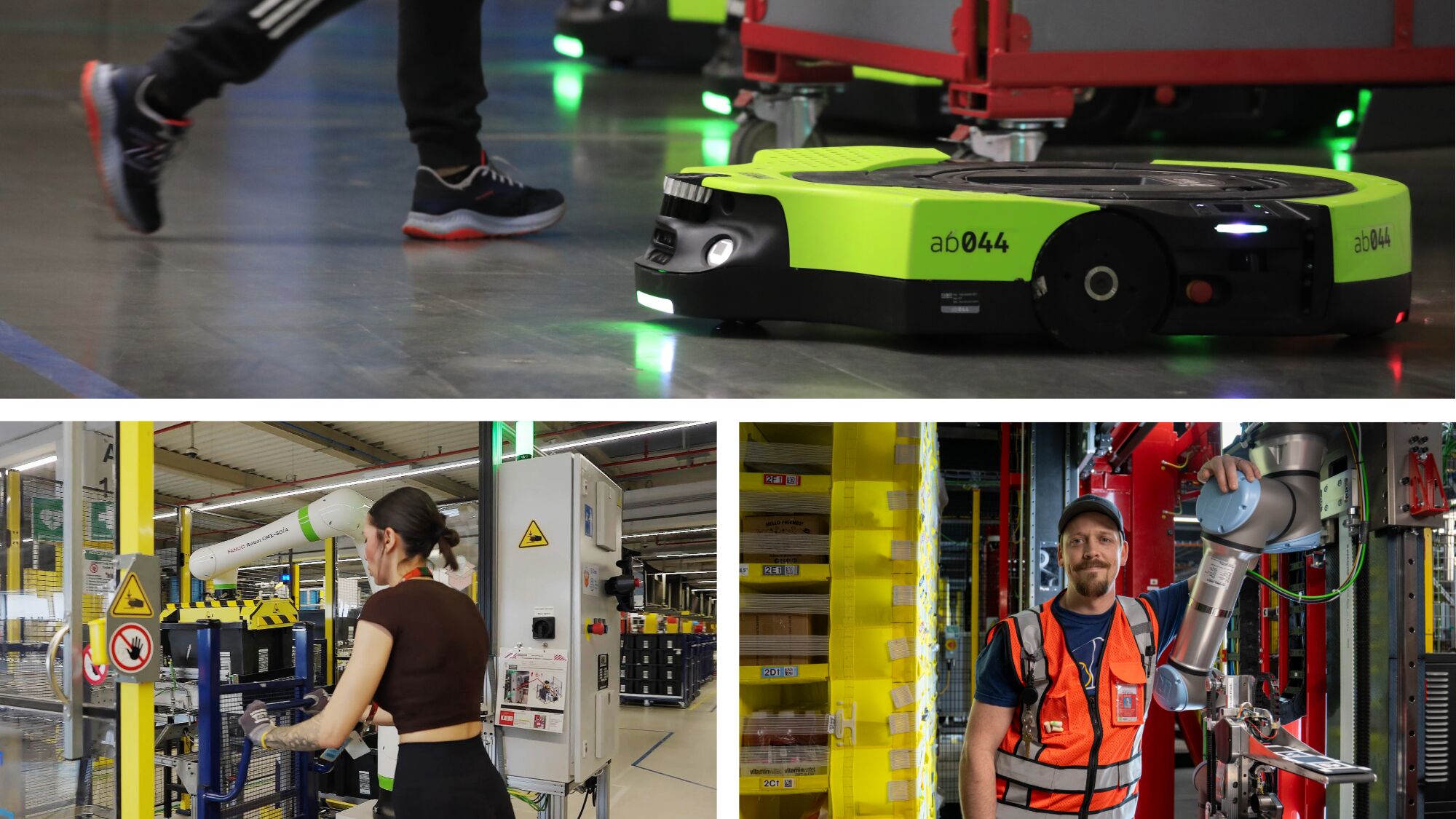
The clearest deployment evidence concerns the previous Proteus system, not the newly announced version. Amazon says the original robot is currently deployed at 25 fulfillment centers in the United States, where it operates in dock areas, moves heavy carts and navigates around people. Those carts can weigh close to 400 kilograms, according to the company. The task is deliberately narrow but consequential: reduce the need for employees to push carts, lift heavy items and walk long distances, while people remain responsible for inventory flow and quality control. This is the part of the announcement that belongs in the present tense. It describes a defined operating environment, a repeatable material-movement job and a stated footprint. It does not establish that the next-generation Proteus is already working across European sites. What the next generation is designed to change Amazon says the new Proteus is designed to move beyond dock areas and work anywhere items need to travel across fulfillment centers and delivery sites. Proposed tasks include transporting containers as they arrive, transferring them between workstations and assisting employees at different points in a facility. The interface is also part of the announcement. Employees are expected to give instructions in plain, conversational language rather than use technical commands or a programming interface. Amazon describes the robot as working out the priority, route and timing after receiving an instruction. That could lower the interaction barrier for a material-movement task, but the announcement provides no independent measurements for command accuracy, recovery time, uptime, throughput or the conditions under which a request is rejected. The capability is therefore best read as a design claim under evaluation, not as a proven general-purpose conversational operator. The timeline matters Amazon introduced the next-generation Proteus at its Delivering the Future event in London. The same announcement says the system is currently being piloted in Amazon’s labs, with European deployment planned for the first half of 2027. For readers assessing what can be demonstrated or rented today, those two facts should stay together. A public event demonstration can show that a machine exists and can perform selected actions. A lab pilot can reveal more about development, but it is still not a production deployment. A planned European rollout is a prospective milestone. The company’s existing U.S. Proteus footprint is real-world evidence, yet it should not be used to imply that the new model has already cleared the same operational, safety and integration work in Europe. Two related systems, different evidence The European investment also covers other robotics work. STARK, Amazon’s collaborative tote-handling system, was first piloted in Barcelona, Spain, and Amazon says it is planned for expansion to 15 European sites by 2027. Vulcan, described by Amazon as its first robotic system with a sense of touch, has expanded to more complex picking tasks at the company’s Hamburg facility in Germany. Those examples strengthen the picture of a wider robotics program, but they should not be bundled into proof that Proteus is already deployed in Europe. STARK is a separate tote-handling system. Vulcan addresses robotic picking and stowing. Proteus is the mobile material-movement platform. Keeping the systems and their maturity labels separate is essential when a single investment announcement presents them together. Safety and operational limits Proteus is not presented as a humanoid or an all-purpose warehouse worker. Its practical value is tied to moving carts and containers through defined sites. The company’s description of the existing robot navigating around people is useful evidence of intended operation, but it is not a substitute for a site-specific risk assessment or a published performance record for the next generation. Before treating the European plan as deployment-ready, an operator would need to verify the actual operating envelope: routes and traffic priorities, load and cart compatibility, human-robot separation, permitted natural-language commands, stop and recovery behavior, supervision, charging, maintenance and escalation when the robot cannot complete a task. None of those details is supplied here as a finished European specification. The prudent reading is that the pilot must answer them. Bottom line Amazon’s announcement is meaningful because it connects a mobile robot already working in 25 U.S. fulfillment centers with a broader, more flexible version intended for conversational task assignment. But the evidence has three different labels: the original Proteus is deployed, the next generation is in lab pilots, and its European rollout is planned for the first half of 2027. That distinction is the real news for robotics buyers and operators. Proteus may become a wider material-movement assistant, but today’s verified story is an established U.S. deployment paired with a European expansion still moving through evaluation. Official sources Official source: aboutamazon.com Related reading Nvidia Lg Robotics Platform Simulation Factory Nasa Rsgs Launch In Space Robot Servicing Test