Confirmed facts
NVIDIA has announced the NVIDIA Factory Operations Blueprint, or FOX, at GTC Taipei during COMPUTEX. The reference design is intended to help developers build an autonomous factory manager that connects industrial data, machines, applications and robot fleets. Its immediate significance is architectural: FOX focuses on coordinating an existing operation rather than introducing a robot platform built for one isolated task.
Source statements
What FOX is designed to coordinate
Newsroom analysis
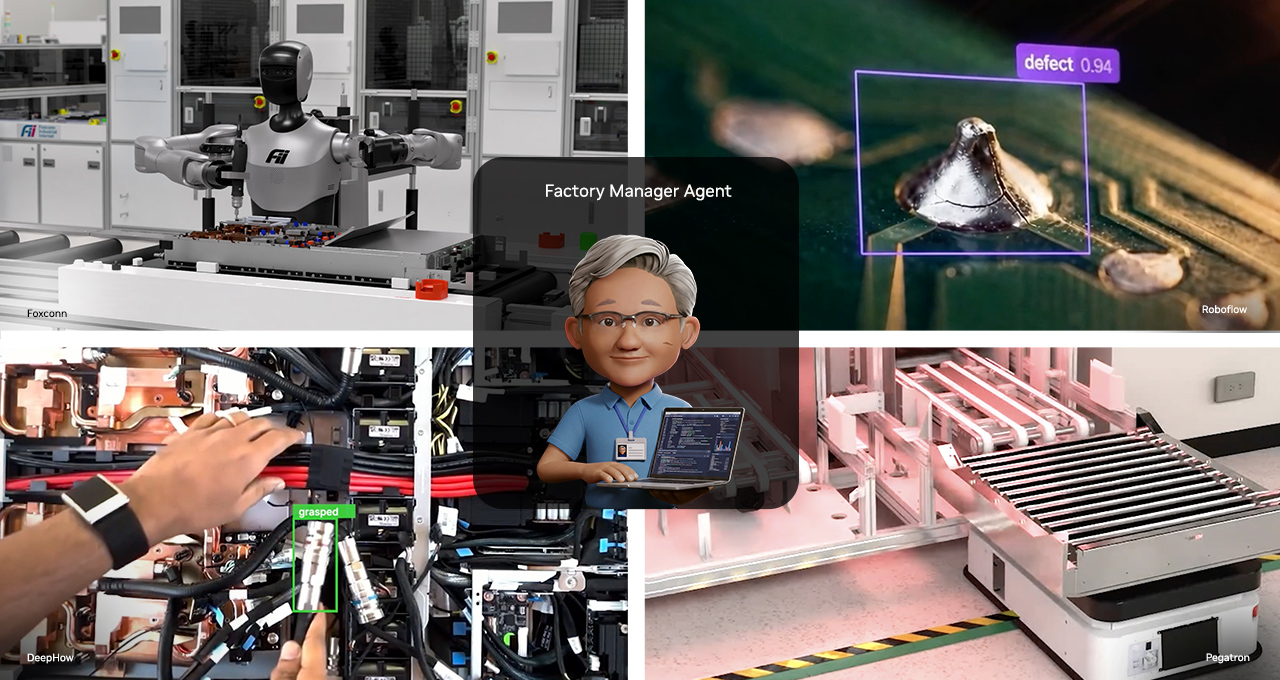
An agent manager built with FOX is designed to monitor and analyse machine signals, quality systems, work instructions and operational alerts in real time. It can then orchestrate specialist agents and machines for tasks including visual inspection, process compliance and material transport. NVIDIA says developers can connect those specialist agents through standard APIs and agent skills, giving software teams a defined compatibility point when adding capabilities from different parts of an industrial stack. This approach is aimed at factories where the useful result depends on a chain of decisions shared between inspection, production and logistics systems. FOX is also designed to integrate with factory data sources, machines, applications and robot fleets. Real-time factory data can be visualised in an operational digital twin built with NVIDIA Omniverse libraries, creating a visibility and control layer for factory workflows. That description does not establish that every connected machine can operate without human oversight. Where manufacturers say they are applying it NVIDIA presents Advantech, Foxconn, Pegatron and Wistron as the first Taiwanese manufacturers deploying autonomous factory manager agents with FOX and NemoClaw. Foxconn is using the two systems to build MoMClaw, a multi-agent industrial operations system that links sensors, machine signals and other digital systems to hundreds of specialist agents. Its natural-language interface is intended to give managers and operators real-time answers and action plans, supported by NVIDIA OpenShell privacy controls and safety guardrails. The performance figures associated with these deployments are manufacturer projections, not independent test results. Foxconn projects an 80% improvement in root-cause analysis time, a 15% increase in labour productivity and a 10% reduction in machine failure rates. Pegatron estimates a 15% reduction in asset redundancy costs. Advantech has deployed an energy-management agent in its own factories, using specialist agents for heating, ventilation, air conditioning and lighting, with a target of cutting energy consumption by 10%. The integration promise still needs evidence Wistron is using FOX alongside NVIDIA Cosmos, open NVIDIA Nemotron models and the NVIDIA Metropolis VSS blueprint to build surface-mount technology agents for line analysis and orchestration, including root-cause analysis and quality control. NVIDIA’s TAO skills are intended to automate the model-training cycle from identifying accuracy gaps through redeployment in production. That could reduce maintenance work when model performance changes, although the announcement does not establish how consistently the process performs across installations. The central trade-off is straightforward. A shared manager may make heterogeneous factory systems easier to coordinate, but it also concentrates decisions across data feeds, software agents and machines. NVIDIA describes a centralised and secure foundation and points to OpenShell guardrails. The available information does not include an independent safety assessment, regulatory approval, deployment timeline or confirmed public availability. The FOX page currently invites readers to register for availability updates. For developers, the next meaningful checkpoint is compatibility and safety evidence from a real installation. FOX marks NVIDIA’s push toward agent-based orchestration across robots and industrial software, while the named manufacturers and projected gains show where the approach is being applied. Until availability and deployment evidence become clearer, FOX is best understood as a development blueprint for integrating factory systems, not proof of a finished autonomy guarantee. Official sources Official source: blogs.nvidia.com Related reading Figure Project Go Big Human Video Helix Not Deployment Nvidia Halos Os Safety Compatibility Robotaxi Development