Confirmed facts
Figure has announced Project Go-Big, a large-scale humanoid pretraining data effort. In its September 18, 2025 announcement, the company said collection had already started in Brookfield environments, while describing expansion over the following months as a future step. The immediate development is therefore a training programme in real environments, not a completed deployment of Helix.
Source statements
Project Go-Big is a partnership with Brookfield Asset Management. Figure identifies more than 100,000 residential homes, 500 million square feet of offices and 160 million square feet of logistics space among the relevant Brookfield environments. Those figures indicate the potential scale of the partner’s property network; they do not mean Helix has been deployed across every site.
Newsroom analysis
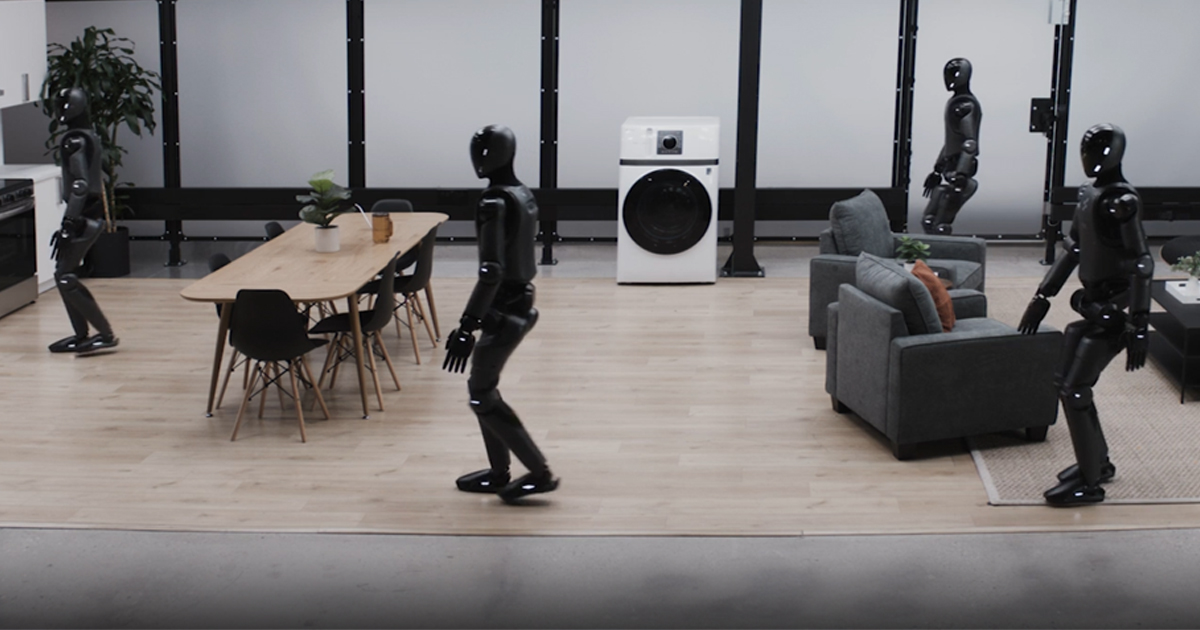
Helix is trained from human video Figure’s central claim is that Helix was trained on 100% egocentric human videos, with no robot demonstrations. The videos were collected passively while people carried out actions in real Brookfield homes. Instead of recording a robot being guided through each task, the programme uses observations of human behaviour as training data. That makes the data pipeline itself the notable change: Figure is trying to transfer information from human activity into humanoid control. Figure also reports that Helix responds to conversational navigation commands and generates closed-loop control for movement in real, cluttered domestic environments. A single Helix network produces high-frequency dexterous manipulation commands and navigation commands at the same time. These are the capabilities presented as current results in the announcement. They do not establish that the system can handle every home, task or operating condition. What the announcement does—and does not—claim Figure calls the result, to its knowledge, the first end-to-end humanoid transfer from images and language to SE(2) velocity commands using only human videos. The qualification matters: it presents the statement as Figure’s own characterization rather than an independently established industry-wide ranking. The technical description is also narrower than a claim of general-purpose operation. It identifies a transfer from images and language to navigation commands, alongside dexterous control, rather than announcing a finished service. For robotics researchers and operators, the immediate result is real-environment data collection within a large property and logistics context. For anyone assessing humanoid deployments, the boundary is just as important. Figure says collection has begun, but the programme’s broader expansion belongs to the months ahead. The announcement does not report a completed rollout of Helix across Brookfield’s portfolio, nor does it establish routine operation at that scale. Project Go-Big therefore sits between a laboratory-only prototype and a finished operational deployment. It describes a human-video training result and data collection in real environments, while leaving the larger scale-up as future work. Until that next phase is reported, the firmest conclusion concerns how Figure is training Helix—not where the humanoid is already working at scale. Official sources Official source: figure.ai Related reading Nvidia Halos Os Safety Compatibility Robotaxi Development Boston Dynamics Stretch Real Warehouse Work Clear Limits