Confirmed facts
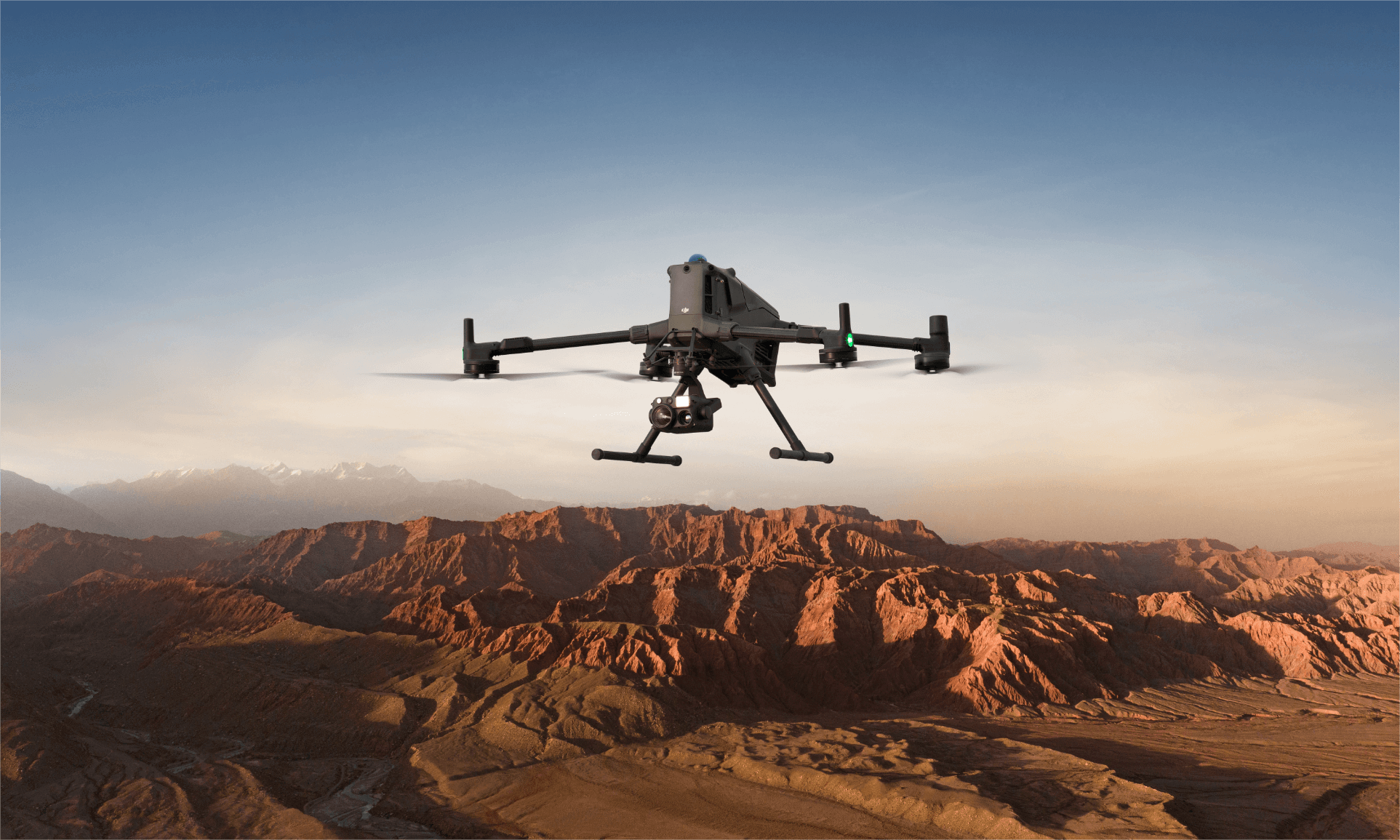
DJI’s Matrice 400 announcement matters to field-robotics teams because it presents an aerial platform around integration constraints rather than a single camera mission. The aircraft is positioned for emergency response, power-line inspection, mapping, engineering and construction. Those are demanding environments, but the announcement is not evidence of a completed deployment or a substitute for an operational risk assessment. The useful question for developers is narrower: what can be connected, what does the safety system actually cover, and what still has to be verified before flight?
Source statements
A long-endurance platform with a defined payload ceiling
Newsroom analysis
DJI describes the Matrice 400 as an enterprise flagship with up to 59 minutes of forward flight time, including a payload, and up to 53 minutes of hovering. The figures are measured under controlled conditions, so they should be treated as planning references rather than guaranteed mission duration. Wind, temperature, altitude, battery condition, payload mass and flight profile will change the usable reserve. The platform has four external E-Port V2 ports and supports up to seven payloads at the same time, with a stated maximum payload capacity of 6 kg. The official specifications add an important qualification: the payload limit depends on the mounting configuration, and capacity decreases as altitude increases. That makes the payload matrix more important than the headline number. A team planning thermal inspection, mapping and lighting in one sortie should calculate the complete aircraft configuration, not simply add the advertised weights. The announcement lists DJI and third-party payload compatibility, including the Zenmuse H30, L2, P1, S1 and V1 systems, as well as the Manifold 3 embedded computer. For developers, the E-Port V2 Development Kit and the platform’s accessory interfaces are more significant than the camera list: they provide the starting point for custom sensing, onboard processing or mission-specific tooling. Compatibility still needs to be checked at the electrical, mechanical, software and thermal levels. DJI’s FAQ also asks payload manufacturers to provide a test report for safe flight during low-battery conditions when non-DJI payloads are used. Sensing helps, but it does not remove the pilot’s job The Matrice 400 combines omnidirectional vision, rotating and upward LiDAR, a downward infrared range sensor and six-direction mmWave radar. DJI says the system can detect power lines and other obstacles in difficult inspection environments, including at night. It also supports terrain following, Smart Detection and an airborne video relay mode intended to improve operations where terrain blocks the signal. These capabilities should be understood as risk-reduction tools, not as proof of autonomous flight in every environment. The official FAQ states that obstacle-sensing performance can vary with fog, rain, snow, lighting and the material, position or shape of the target. It also states that the aircraft cannot actively avoid fast-moving objects. The mmWave radar function may be unavailable or restricted in some countries or regions. A field procedure should therefore define a human observation zone, a lost-link response, a recovery route and a clear abort condition even when obstacle sensing is enabled. The IP55 rating does not mean unrestricted all-weather operation. DJI’s FAQ says not to fly in rain heavier than 100 mm over 24 hours and warns that ingress protection can decline with wear. For outdoor teams, weather monitoring, inspection of seals and connectors, and post-flight drying are operational controls, not optional maintenance details. Regulatory labels are configuration-dependent DJI’s FAQ identifies the Matrice 400 as C3 certified in Europe. It says that, when paired with the DJI AP100 Parachute, the aircraft can meet C5 or C6 and UK5 or UK6 operational safety requirements under the stated conditions. The distinction matters: the FAQ says that C6 or UK6 status requires a factory-certified system, so mounting a parachute on an existing aircraft does not automatically create a C6 platform. The same page records a safety trade-off that should be included in a configuration review. When the AP100 Parachute is mounted, the aircraft automatically disables its downward and backward mmWave radars to avoid obstructing deployment and preventing false triggers. Small obstacles in those directions may then be harder to sense, leaving the pilot responsible for manual avoidance. A regulatory accessory can therefore change the sensing profile; it should never be treated as a simple add-on with no operational consequences. Operators must still check the rules and airspace procedures that apply where the mission will occur. Certification class, pilot competency, operating category, visual-line-of-sight conditions, flight restrictions and permissions are separate questions. The Matrice 400’s transmission range, automation features or payload capacity do not themselves authorize a flight. What the announcement means for field developers The Matrice 400 is a credible platform candidate for teams that need a configurable aerial robot rather than a lightweight survey drone. Its strongest fit is a repeatable workflow in which the payload, data path and safety case are known before deployment: for example, a power-line inspection package, a search-and-rescue configuration or a mapping setup with a defined return reserve. A sensible acceptance checklist should confirm the exact aircraft and battery configuration, payload mass and mounting point, firmware compatibility, sensor availability in the operating region, communications assumptions, data-storage policy and local flight permissions. DJI says Local Data Mode can disconnect the DJI Pilot 2 application from the internet, and that flight logs, images and video are not synced to DJI servers unless authorised by the operator. That is useful for sensitive missions, but teams should test offline activation, map availability, data export and incident recovery before taking the aircraft to a remote site. The announcement supports a capable multi-payload field platform, not a universal autonomous solution. Its practical value will depend on disciplined configuration control, conservative flight planning and a safety case that includes the system’s known sensing and weather limits. Official sources Official source: enterprise.dji.com Official source: enterprise.dji.com Official source: enterprise.dji.com Related reading Nasa Lunar Robot Research Armadas Cadre Autonomy Boston Dynamics Waltham Hub Real Robot Work Future Plans