Hechos confirmados
Hirebotics’ October 6, 2024 preview for FABTECH 2024 centered on a practical question for industrial cobot welding: how much of the setup can an operator teach and adjust without rebuilding an entire program? At booth W4755, Hirebotics and its OEM partner Vectis planned to present new functions for welding systems based on Universal Robots’ UR10e and UR20 platforms.
Declaraciones de la fuente
Teaching welding points at the torch
Análisis de la redacción
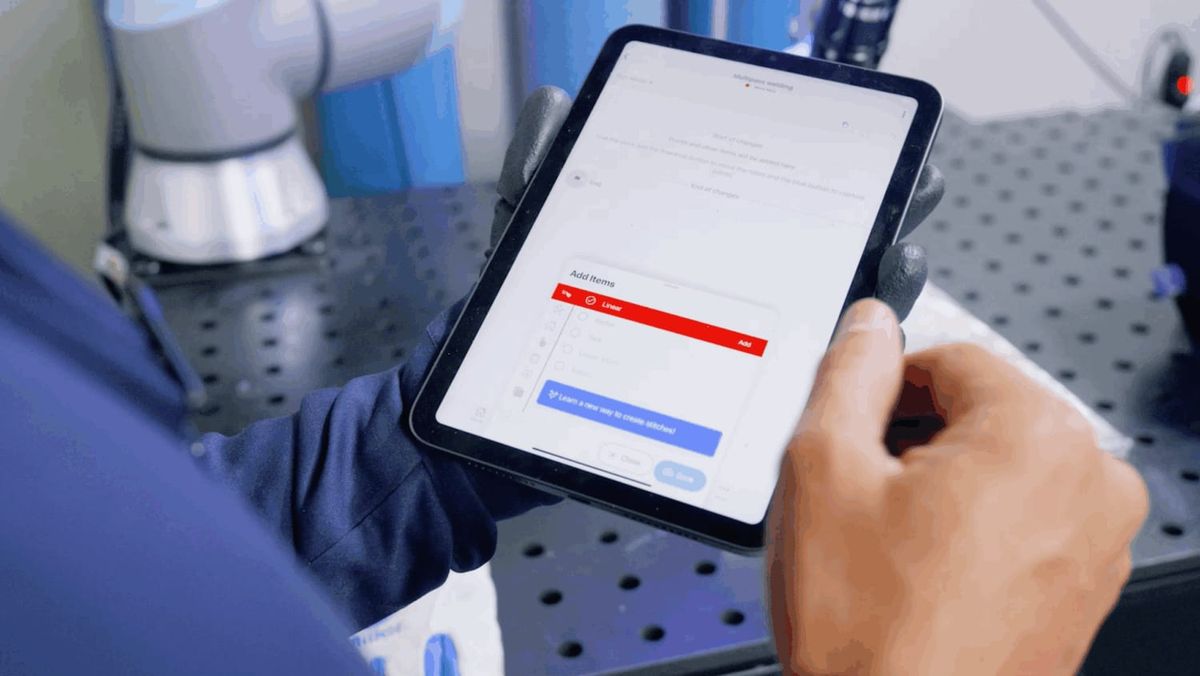
Vectis was due to demonstrate QuickTeach, a feature that lets an operator teach points directly at the cobot’s torch and optimize trajectories from that position. The approach moves part of the programming task closer to the physical point where the weld is being prepared. For a fabricator working on a new part or correcting a path, the proposed benefit is a more direct way to define the cobot’s motion. Vectis also planned to show AI Path Optimization. Hirebotics described the feature as support for operators at every skill level who need to teach consistent, high-quality welds. The two functions address different stages of the workflow: QuickTeach is presented as a way to establish where the cobot should move, while the optimization feature is intended to refine that path and support more consistent results. Stitch welding with more control over point order Hirebotics was set to show enhanced stitch welding for complex paths, including the ability to reorder stitch-weld points. That matters when the sequence of individual welds affects the job and cannot be treated as a simple straight-line pass. It gives the workflow more flexibility for parts that require intermittent welds, although the preview supplied no cycle-time data, weld-quality measurement or production-deployment result. Beacon brings task changes beyond the cell Hirebotics’ smartphone-based Beacon platform was also part of the planned presentation. Beacon allows users to teach cobot tasks, monitor them remotely and modify them remotely. The system was available on the UR teaching pendant, while the demonstration was expected to show participants teaching UR cobots from iOS, Android, the web or the pendant through the Polyscope interface. Multiple interfaces could reduce the need to remain at the welding cell for every task adjustment. That is a workflow change, not by itself a safety validation for a particular installation. Remote access does not establish that a welding application can be supervised safely from any location, and the preview did not report a deployment outcome, availability date or performance benchmark. The information supports a narrower conclusion: Hirebotics and Vectis were presenting tools intended to simplify teaching, trajectory refinement, stitch-weld sequencing and remote task management on UR10e- and UR20-based welding systems. The preview did not establish that every welding job could be automated, that the features were suitable for every production environment or that remote changes removed the need for on-site safety procedures. For professional users, the immediate promise was therefore a more accessible programming workflow rather than proof of universal welding automation. The value of these features would still depend on how a given cell is configured, how its safety requirements are validated and whether the proposed controls deliver measurable production benefits in practice. Official sources Official source: hirebotics.com Related reading Nvidia Fox Blueprint Factory Robot Fleet Orchestration Figure Project Go Big Human Video Helix Not Deployment